Davidt8 · Public domain · via Wikimedia Commons
We earn a commission if you book through the links below. How this works
Ghost stories gather where history was hardest. Prisons, battlefields, old cemeteries and grand hotels where something went wrong all collect legends, and every October visitors go looking for them.
We don't claim any of these places is haunted. What we can vouch for is the history: each landmark below is real, each story is told as it is told, and each is worth visiting by daylight as much as after dark. The legends are the reason many people first come. The history is the reason to stay.
Eastern State Penitentiary, Philadelphia
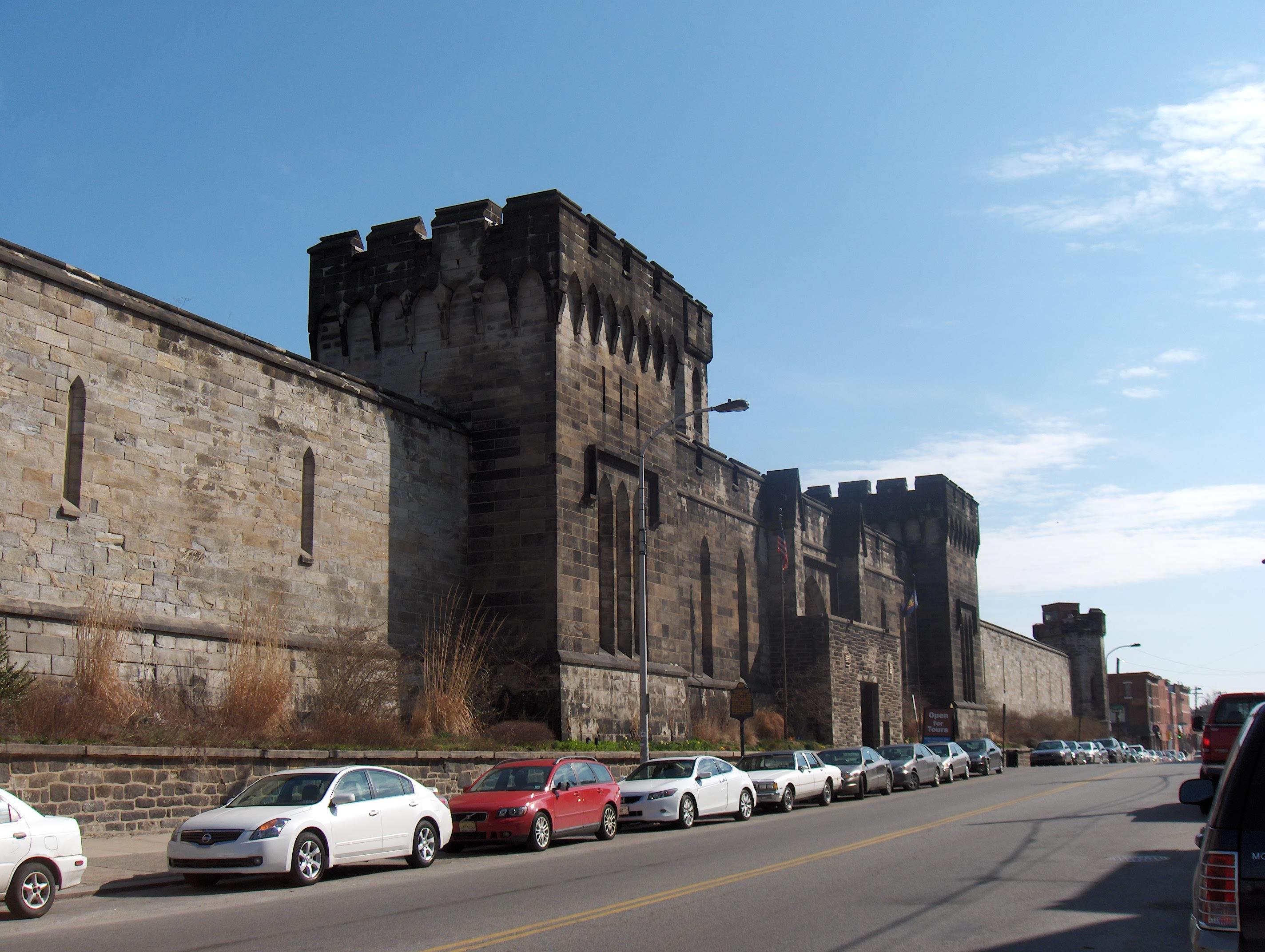
When Eastern State opened in 1829, it was built on a radical idea: that prisoners kept in solitary confinement, with only a Bible and their conscience for company, would come to repent. Its wagon-wheel plan, with cellblocks radiating from a central hub, was copied by more than 300 prisons around the world, but the isolation it imposed came to be condemned as cruel. The prison held inmates for 142 years, Al Capone among them in 1929 and 1930, before it closed in 1971.
Its crumbling cellblocks are often called one of the most haunted places in Pennsylvania, and paranormal investigators visit regularly. The stories told are of footsteps, voices and shadows in corridors that have stood empty for half a century.
Alcatraz Island, San Francisco
From 1934 to 1963, Alcatraz was the federal government's maximum-security prison, the place for inmates other prisons couldn't hold. Its most feared cells were in D-Block, the segregation unit, where the solitary cells known as the Hole kept men in darkness as punishment.
Guards, rangers and visitors have traded stories about the cellhouse ever since it closed: cold spots in the solitary cells, voices and the clang of doors after the last visitors have gone. Most of the island's ghost stories gather in D-Block.
Gettysburg Battlefield, Pennsylvania
Over three days in July 1863, the Union and Confederate armies fought the largest battle of the Civil War across the fields and ridges around this small Pennsylvania town, at a cost of some 51,000 casualties. Among the dead was Jennie Wade, 20, struck by a stray bullet on July 3 while baking bread in her sister's house: the only civilian killed in the battle.
Few places in America have more ghost stories. Mark Nesbitt, a former park ranger, collected them in Ghosts of Gettysburg, first published in 1991: figures among the boulders of Devil's Den, where sharpshooters fought, cameras that fail there, and the sounds of a battle long over.
Hotel del Coronado, Coronado
Built in less than a year on a sandspit across the bay from San Diego, the Hotel del Coronado opened in 1888 and remains one of the largest wooden buildings in America.
On Thanksgiving Day 1892, a 24-year-old woman checked in alone under the name Lottie A. Bernard. Five days later she was found dead on a staircase leading down to the beach, shot in the head. Her death was ruled a suicide, and she was identified as Kate Morgan. Guests have reported strange happenings in her room ever since — it was number 302 then and is 3327 today — and the hotel tells her story itself.
The White House, Washington
The White House has been the president's home since 1800, and every president except George Washington has lived there.
Its most famous ghost is Abraham Lincoln. The stories go back at least to 1903, when a longtime White House employee, Jerry Smith, described seeing him in a newspaper interview. In the 1920s, First Lady Grace Coolidge said she had seen Lincoln at a window of the Yellow Oval Room, looking out toward the Potomac. Later tales, retold by the White House Historical Association, add Winston Churchill and Queen Wilhelmina of the Netherlands to those who claimed an encounter.
Savannah Historic District, Georgia
Laid out in 1733 around a grid of public squares, Savannah is Georgia's oldest city. Its historic core came through the Civil War and 20th-century demolition alike, and the city lived through wars, fires and yellow fever epidemics on the way.
In 2002 the American Institute of Parapsychology named Savannah “America's most haunted city,” and the title stuck. Its squares and old houses, and Colonial Park Cemetery, established in 1750, are the stops on most of its many ghost walks.
The French Quarter, New Orleans
French colonists laid out New Orleans in 1718, though most of the Quarter's iron balconies and courtyards date from Spanish rule, rebuilt after fires in the late 1700s.
Just beyond its edge, St. Louis Cemetery No. 1, opened in 1789, is the oldest surviving cemetery in the city, its dead laid in above-ground tombs. Among them, by tradition, is Marie Laveau, the 19th-century “Voodoo Queen” of New Orleans, whose tomb visitors still mark and leave offerings at.
Tombstone, Arizona
Tombstone boomed on silver from 1879, and in October 1881 the gunfight near the O.K. Corral made it a legend. The men killed in that fight lie in Boothill, the town's old cemetery.
The Bird Cage Theatre opened in December 1881 as a theater, saloon, gambling hall and brothel, ran around the clock until 1889, and still shows the bullet holes in its walls. Its keepers say its ghosts never left: visitors tell of music, laughter and cigar smoke in the empty rooms.
Seeing them after dark
Most of these places are as rewarding by day: a ghost walk in the evening and a daytime visit tell two halves of the same story. Book October evenings early, and where a site runs its own tours, they are the ones that take you inside.