- Antebellum (1815–1861)
- 29.9584° N, 90.0644° W
French Quarter
New Orleans, Louisiana · Established 1718
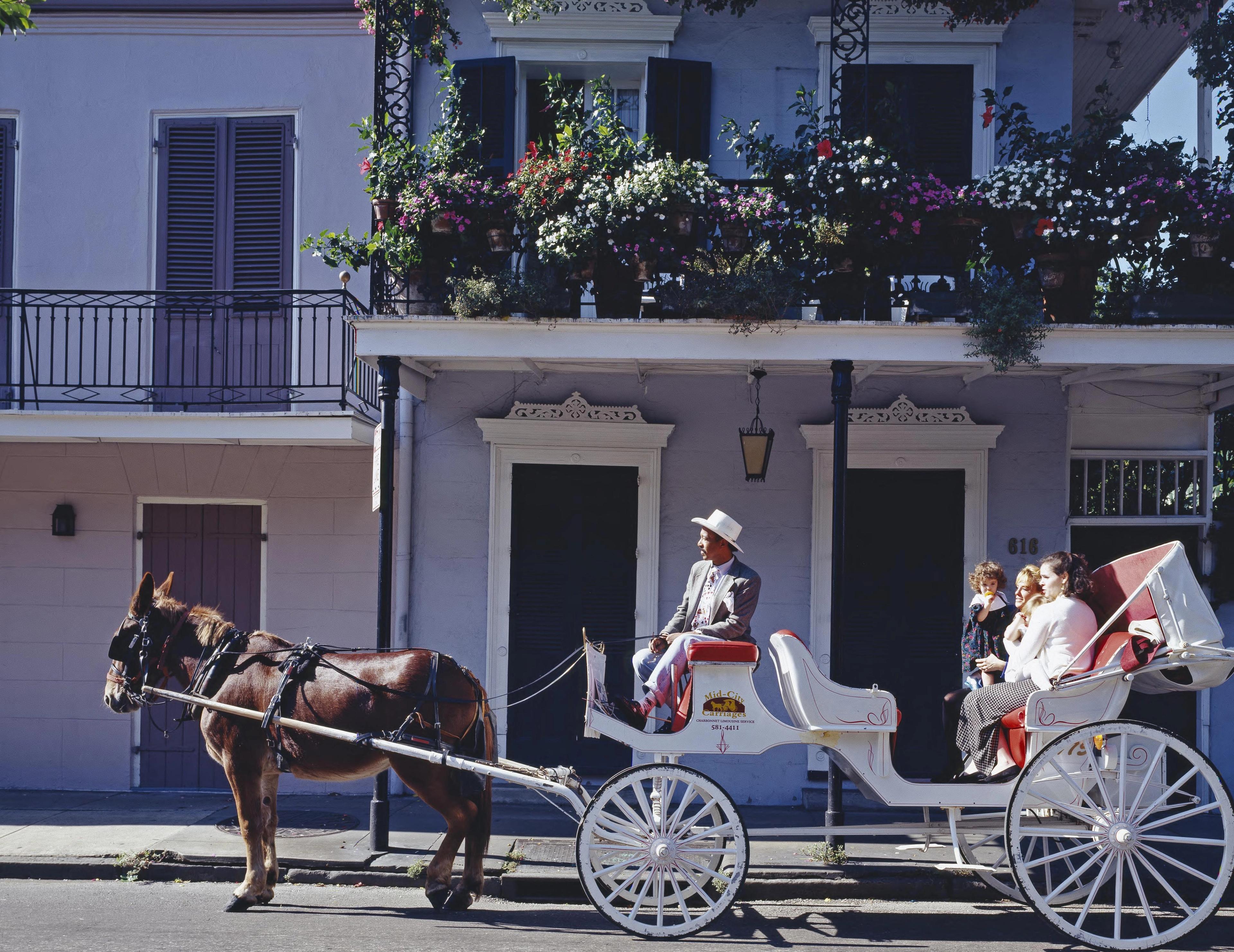
Carol M. Highsmith Archive, Library of Congress · No known restrictions · via Library of Congress
Why It Matters
The French Quarter — the Vieux Carré, or 'Old Square' — is the historic heart of New Orleans and one of the most distinctive neighborhoods in America. Laid out by French colonists in 1718, it is the city's original settlement, though its lacework iron balconies and pastel courtyards are largely Spanish colonial, rebuilt after fires in the late 1700s. A living district of Creole culture, jazz, and cuisine, it remains the cultural soul of the city and a National Historic Landmark.
The History
New Orleans was founded in 1718 by the French colonizer Jean-Baptiste Le Moyne de Bienville, who laid out a compact grid of streets on the banks of the Mississippi around a central parade ground, the Place d'Armes — today's Jackson Square. This original settlement became known as the Vieux Carré, the 'Old Square,' and later, in English, the French Quarter.
Although the name honors its French founders, most of the Quarter's oldest surviving buildings date from the Spanish colonial era, when Louisiana belonged to Spain from 1763 to 1803. Two devastating fires, in 1788 and 1794, destroyed much of the original French town, and it was rebuilt in the Spanish style — giving the district its characteristic courtyards, stucco walls, and wrought- and cast-iron balconies. In 1803 the United States took possession of Louisiana in the Louisiana Purchase, with the transfer ceremony held at the Cabildo on the square.
Through the 19th and 20th centuries the French Quarter remained the cultural core of New Orleans, home to a Creole society and, later, a birthplace of jazz. Its landmarks — St. Louis Cathedral, the Cabildo and Presbytère, the French Market, and the storied length of Bourbon Street — anchor a neighborhood famous for Mardi Gras, music, and food. It was designated a National Historic Landmark in 1965, and a preservation commission protects its historic character.
Through the Years
- 1718
Bienville founds New Orleans and lays out the Vieux Carré.
- 1763
Louisiana passes to Spain, beginning the Spanish colonial era.
- 1788 & 1794
Two great fires destroy much of the French town; it is rebuilt in Spanish style.
- 1803
The Louisiana Purchase transfers New Orleans to the United States.
- 1850
The present St. Louis Cathedral is completed on Jackson Square.
- 1965
The French Quarter is designated a National Historic Landmark.
The Archive
 Plate 01
Aerial photograph of Jackson Square, French Quarter
Jordon Dopp · CC BY-SA · via Wikimedia Commons
 Plate 02
French Quarter clown, New Orleans, Louisiana
Carol M. Highsmith Archive, Library of Congress · No known restrictions · via Library of Congress
 Plate 03
French Quarter Balcony, New Orleans, Louisiana
Carol M. Highsmith Archive, Library of Congress · No known restrictions · via Library of Congress
 Plate 04
French Quarter Neon Signs, New Orleans, Louisiana
Carol M. Highsmith Archive, Library of Congress · No known restrictions · via Library of Congress
Facts & Figures
The District
- Also known as
- The Vieux Carré ('Old Square')
- Founded
- 1718, by the French
- Architecture
- Largely Spanish colonial / Creole
Heart of it
- Central square
- Jackson Square (the former Place d'Armes)
Landmarks
- Around the square
- St. Louis Cathedral, the Cabildo, the Presbytère
Culture
- Known for
- Jazz, Creole cuisine, and Mardi Gras
Status
- Designation
- National Historic Landmark district (1965)
The Register
- Established
- 1718
- Architectural style
- Spanish colonial / Creole
- Builder
- Founded by Jean-Baptiste Le Moyne de Bienville (1718)
- Area of significance
- Urban colonial & Culture
Frequently Asked
Why is it called the French Quarter?
It was founded by French colonists in 1718 as the original city of New Orleans, and its French name is the Vieux Carré, or 'Old Square.' Much of its architecture, however, is Spanish colonial.
Why does the French Quarter look Spanish?
Two great fires in 1788 and 1794 destroyed most of the original French buildings during the period when Louisiana was ruled by Spain, so the district was rebuilt in the Spanish colonial style.
What is there to see in the French Quarter?
Highlights include Jackson Square, St. Louis Cathedral, the Cabildo and Presbytère museums, the French Market, and the music and nightlife of Bourbon and Royal Streets.
Is the French Quarter a historic landmark?
Yes. The entire Vieux Carré was designated a National Historic Landmark in 1965, and a local commission works to preserve its historic architecture and character.