- Westward Expansion (1803–1890)
- 29.4260° N, 98.4861° W
The Alamo
San Antonio, Texas · Established 1744 (mission chapel)
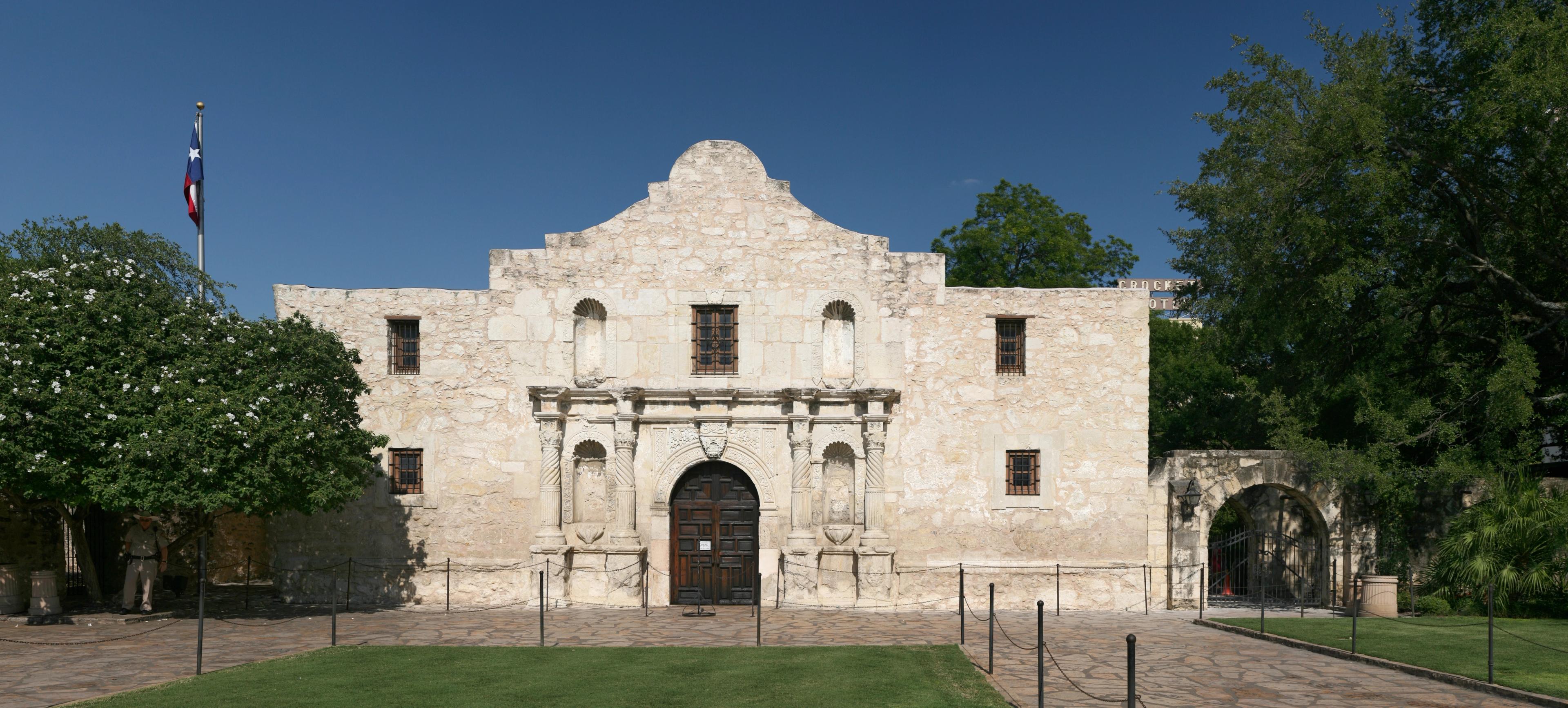
Daniel Schwen · CC BY-SA · via Wikimedia Commons
Why It Matters
The Alamo began as a Spanish mission and became, in 1836, the site of a thirteen-day siege that turned into one of the most famous last stands in American history. Roughly 200 Texian and Tejano defenders held the walls against a much larger Mexican army under General Antonio López de Santa Anna before the garrison was overwhelmed.
“Remember the Alamo” became the rallying cry of the Texas Revolution, which won independence from Mexico weeks later. The mission church that survives today is one of Texas's most visited historic sites and a symbol recognized far beyond the state.
The History
Franciscan missionaries founded Mission San Antonio de Valero in 1718; it moved to its present site in 1724, where its stone chapel was built beginning in 1744. Secularized in the 1790s, the former mission was later garrisoned by soldiers, who gave it the name “Alamo,” Spanish for “cottonwood.”
In February 1836, during the Texas Revolution, a force under Mexican President and General Antonio López de Santa Anna besieged the Alamo, defended by a small garrison of Texian and Tejano volunteers that included William B. Travis, James Bowie, and Davy Crockett. After a thirteen-day siege, Mexican troops stormed the walls on March 6, 1836, killing nearly all of the defenders.
The defeat galvanized the Texian cause; “Remember the Alamo” became a battle cry at the Battle of San Jacinto weeks later, where Sam Houston's forces defeated Santa Anna and secured Texas independence. The Alamo church was preserved beginning in the late 19th century and today is maintained as a historic site and shrine in downtown San Antonio.
Through the Years
- 1718
Mission San Antonio de Valero is founded by Franciscan missionaries.
- 1724
The mission moves to its present site.
- 1744
Construction begins on the stone mission church that stands today.
- Feb 23, 1836
Santa Anna's forces begin the siege of the Alamo.
- Mar 6, 1836
Mexican troops storm the Alamo; nearly all defenders are killed.
- Apr 21, 1836
Texian forces defeat Santa Anna at San Jacinto, winning independence.
The Archive
 Plate 01
A visitor next to a fountain at the Alamo.
Eden, Janine and Jim from New York City · CC BY · via Wikimedia Commons
 Plate 02
A bench with a view of a courtyard at the Alamo
Bruce Peterson · CC BY-SA · via Wikimedia Commons
 Plate 03
A metal gate at the Alamo.
Sozanetta · CC BY-SA · via Wikimedia Commons
Facts & Figures
The Siege
- Siege dates
- Feb 23 – Mar 6, 1836
- Defenders
- ~200
- Mexican forces
- ~1,800–2,400 under Santa Anna
The Mission
- Founded as a mission
- 1718 (moved to this site 1724)
The Register
- Established
- 1744 (mission chapel)
- Architectural style
- Spanish Colonial
- Builder
- Franciscan missionaries (mission); defended by the Texian garrison in 1836
- Area of significance
- Military; Exploration/Settlement
- County
- Bexar
- Acreage
- 5 acres
- National Register ref.
- 66000808
- Listed on the Register
- October 15, 1966
- National Historic Landmark
- December 19, 1960
Frequently Asked
What happened at the Alamo?
In 1836, about 200 Texian and Tejano defenders held the former mission against a siege by Mexican forces under Santa Anna for thirteen days before being overwhelmed on March 6.
Why is it called the Alamo?
“Alamo” is Spanish for cottonwood tree; the name is generally traced to a Spanish cavalry company once stationed at the former mission.
Who died at the Alamo?
Nearly all the defenders, including well-known figures William B. Travis, James Bowie, and Davy Crockett.
Was the Alamo originally a mission?
Yes. It was founded in 1718 as Mission San Antonio de Valero before later being used as a fort.
Can you visit the Alamo?
Yes. It sits in downtown San Antonio and is free to enter, with paid tours and exhibits available.