- The 20th Century (1900–2000)
- 38.6247° N, 90.1848° W
Gateway Arch
St. Louis, Missouri · Established 1965
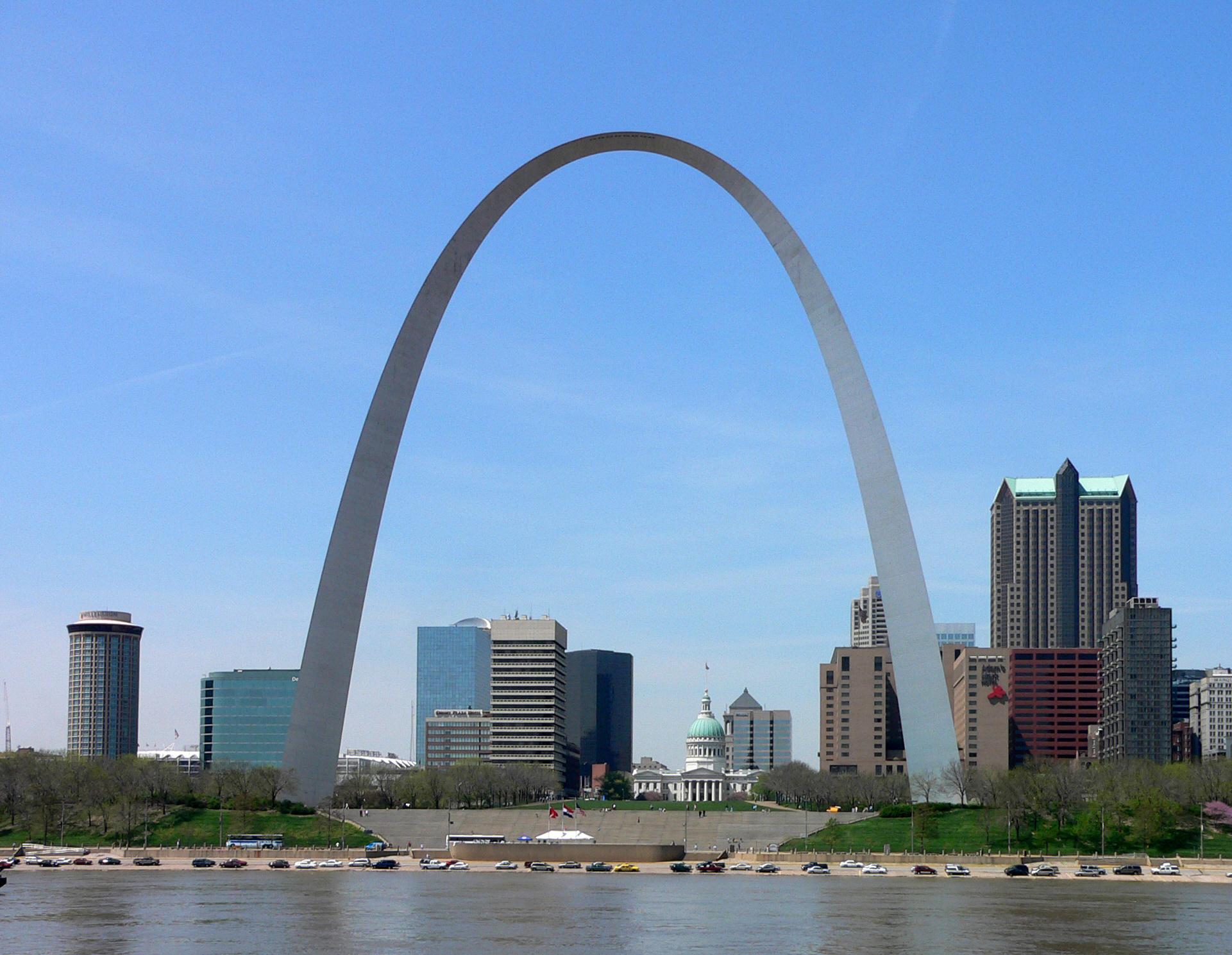
[ https://www.flickr.com/photos/11399912@N00 B0iwehijro2i0- ] `1l]] from Davis, CA, USA · CC BY · via Wikimedia Commons
Why It Matters
The Gateway Arch is the tallest man-made monument in the Western Hemisphere and the defining symbol of St. Louis. Its sweeping 630-foot curve of stainless steel, designed by architect Eero Saarinen, commemorates Thomas Jefferson, the Louisiana Purchase, and the pioneers who set out from here toward the American West. Completed in 1965 on the banks of the Mississippi, it is at once a soaring work of modern sculpture and a monument to the nation's westward expansion.
The History
In the 1930s civic leaders in St. Louis proposed a grand memorial on the Mississippi riverfront to honor the city's role as the 'Gateway to the West' and the westward expansion set in motion by Thomas Jefferson's Louisiana Purchase. A nationwide design competition in 1947-1948 was won by the Finnish-American architect Eero Saarinen, who proposed a single soaring arch of stainless steel.
Saarinen refined the form as a weighted catenary — the shape a hanging chain makes, inverted — 630 feet tall and 630 feet wide at its base. Construction began in 1963, with the two legs built upward independently and meeting at the top with only the slimmest margin for error. The final section was set in place on October 28, 1965. Saarinen, however, had died in 1961 and never saw his design completed.
The completed Arch, clad in gleaming stainless steel, became an instant icon. A unique tram of small pod-like cars carries visitors up through the hollow legs to an observation deck at the summit, with views far across Missouri and Illinois. Part of what was long called the Jefferson National Expansion Memorial — renamed Gateway Arch National Park in 2018 — it is administered by the National Park Service and remains the tallest monument in the Western Hemisphere.
Through the Years
- 1935
A riverfront memorial to westward expansion is authorized in St. Louis.
- 1947-48
Eero Saarinen wins the national design competition for the Arch.
- 1961
Saarinen dies before construction begins.
- 1963
Construction of the Gateway Arch begins.
- 1965
The final section is set in place on October 28.
- 1967
The tram to the top opens to visitors.
- 2018
The memorial is renamed Gateway Arch National Park.
The Archive
 Plate 01
Gateway Arch & St. Louis MO Riverfront at Dawn
Parker Botanical · CC BY-SA · via Wikimedia Commons
 Plate 02
Gateway Arch Framed by Trees
Jefferson National Expansion Memorial, NPS from St. Louis, MO, USA · CC BY · via Wikimedia Commons
 Plate 03
Low angle of Gateway Arch in St.Louis, MO
Levi Jackson · CC BY · via Wikimedia Commons
Facts & Figures
The Arch
- Height
- 630 ft (192 m) — also 630 ft wide
- Form
- Weighted stainless-steel catenary curve
- Architect
- Eero Saarinen
- Built
- 1963-1965
Records
- Distinction
- Tallest monument in the Western Hemisphere
Getting up
- To the top
- A unique tram of pod-like cars
Today
- Operator
- National Park Service
The Register
- Established
- 1965
- Architectural style
- Modernist catenary arch
- Builder
- Eero Saarinen (architect); Hannskarl Bandel (structural engineer)
- Area of significance
- Commemorative monument & Architecture
- County
- St. Louis
- Acreage
- 62.2 acres
- National Register ref.
- 87001423
- Listed on the Register
- May 28, 1987
- National Historic Landmark
- May 28, 1987
Frequently Asked
How tall is the Gateway Arch?
The Gateway Arch stands 630 feet tall and is also 630 feet wide at its base, making it the tallest man-made monument in the Western Hemisphere.
What does the Gateway Arch commemorate?
It honors Thomas Jefferson, the Louisiana Purchase, and the pioneers of America's westward expansion, symbolizing St. Louis's role as the 'Gateway to the West.'
Who designed the Gateway Arch?
The Finnish-American architect Eero Saarinen, who won a national design competition in 1948. He died in 1961, before construction began, and never saw it completed.
Can you go to the top of the Gateway Arch?
Yes. A unique tram of small pod-like cars carries visitors up through the hollow legs to an observation deck at the summit, with sweeping views over St. Louis and the Mississippi River.