- Antebellum (1815–1861)
- 32.0776° N, 81.0912° W
Savannah Historic District
Savannah, Georgia · Established 1733
Ebyabe · CC BY-SA · via Wikimedia Commons
Why It Matters
The Savannah Historic District is one of America's largest and most beautiful historic districts — the graceful heart of the oldest city in Georgia. Laid out in 1733 around a grid of leafy public squares, it preserves a pioneering vision of city planning along with antebellum mansions, cobblestone streets, and live oaks draped in Spanish moss. Spared from destruction in the Civil War and rescued again from demolition in the 20th century, Savannah's historic core is a rare, intact window into the American South's colonial and antebellum past.
The History
Savannah was founded in 1733 by General James Oglethorpe, who landed on a bluff above the Savannah River to establish Georgia, the last of the thirteen original British colonies. Oglethorpe laid out the town on an innovative grid organized around open public squares — a design known as the Oglethorpe Plan that allowed the city to grow ward by ward while preserving green common spaces at its heart.
Over the following century Savannah grew into one of the South's most important ports, shipping cotton to the world and building the elegant mansions, churches, and townhouses that still line its squares. The city was captured near the end of the Civil War when General William T. Sherman completed his March to the Sea in December 1864; rather than burn Savannah, he presented it to President Lincoln as a 'Christmas gift,' and the city was largely spared.
By the mid-20th century, decades of decline threatened the historic core, and several landmark buildings and squares were lost or nearly demolished. A grassroots preservation movement, led by the Historic Savannah Foundation founded in 1955, fought to save the district. Their efforts preserved 22 of the original squares and hundreds of historic buildings, and in 1966 the Savannah Historic District was designated a National Historic Landmark, one of the largest in the country.
Through the Years
- 1733
James Oglethorpe founds Savannah on the Oglethorpe Plan.
- 1700s-1800s
Savannah grows into a major Southern cotton port.
- 1864
Sherman captures Savannah and spares it as a 'Christmas gift' to Lincoln.
- 1955
The Historic Savannah Foundation forms to fight demolition.
- 1966
The Savannah Historic District is designated a National Historic Landmark.
The Archive
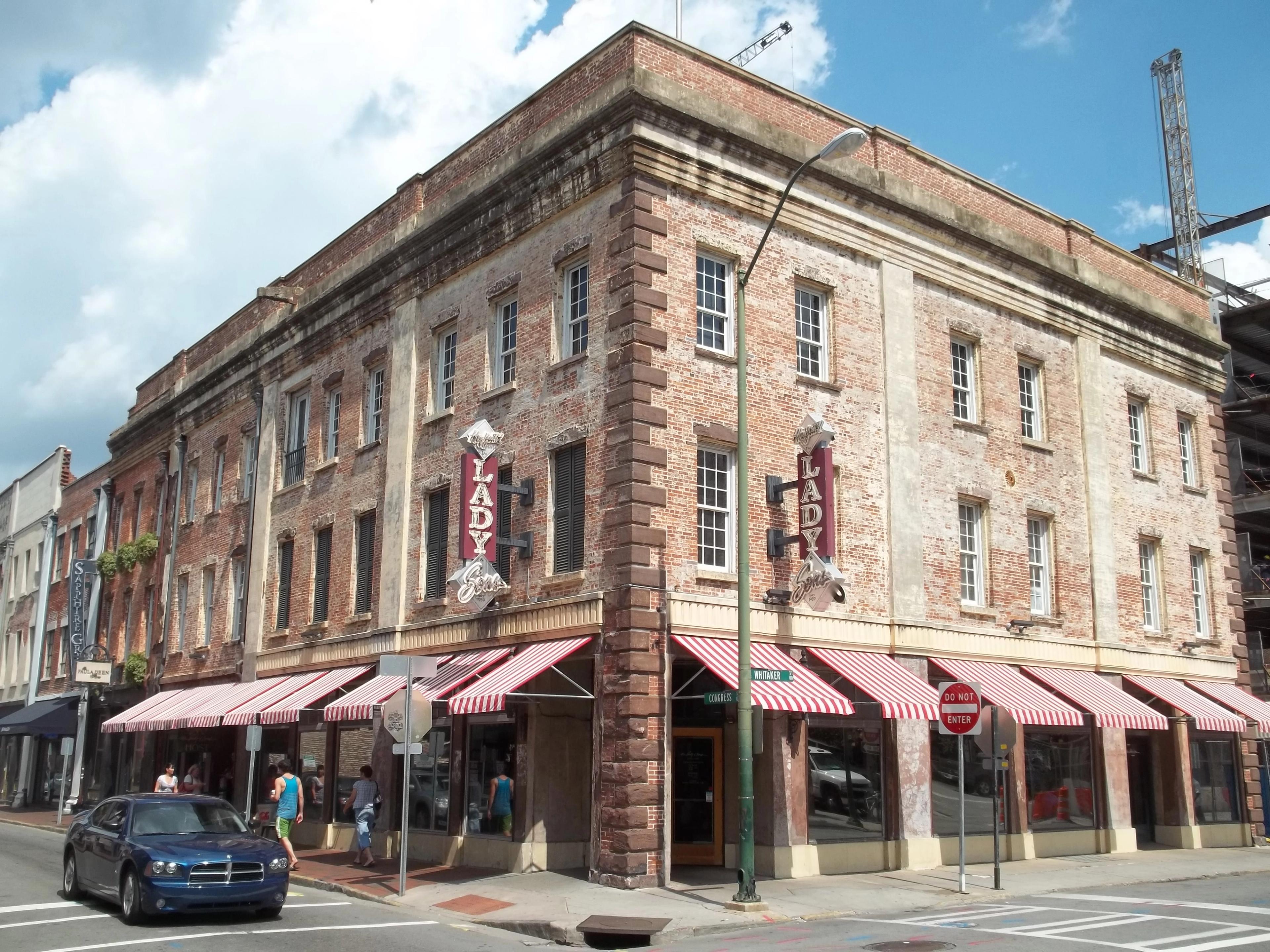
 Plate 01
Historic buildings on West Congress Street, Savannah Historic District.
Ron Cogswell · CC BY · via Wikimedia Commons
 Plate 02
Savannah Morning News Building, Savannah Historic District.
JeffersonLH · CC BY-SA · via Wikimedia Commons
 Plate 03Historic
Savannah Historic District, Helmly Building.
Library of Congress · No known restrictions · via Library of Congress
 Plate 04
Pierce Condon House in Savannah Historic District.
JeffersonLH · CC BY-SA · via Wikimedia Commons
Facts & Figures
The District
- Founded
- 1733, by James Oglethorpe
- Plan
- The Oglethorpe Plan — a grid of public squares
The Squares
- Surviving
- 22 of the original 24 squares
Distinction
- Size
- One of the largest historic districts in the U.S.
Civil War
- 1864
- Spared by Sherman as a 'Christmas gift' to Lincoln
Status
- Designation
- National Historic Landmark district (1966)
Today
- Managed by
- City of Savannah
The Register
- Established
- 1733
- Architectural style
- Colonial & Antebellum (the Oglethorpe Plan)
- Builder
- Founded by Gen. James Oglethorpe (1733)
- Area of significance
- Urban planning & History
- County
- Chatham
- Acreage
- 525 acres
- National Register ref.
- 66000277
- Listed on the Register
- November 13, 1966
- National Historic Landmark
- November 13, 1966
Frequently Asked
Why is Savannah's Historic District famous?
It is one of the largest and best-preserved historic districts in America, laid out in 1733 around a distinctive grid of public squares shaded by live oaks, and lined with antebellum architecture.
What are the Savannah squares?
They are the small public parks at the center of Savannah's grid, part of the original 1733 Oglethorpe Plan. Twenty-two of the original 24 squares survive, each with monuments, fountains, and shade trees.
Was Savannah destroyed in the Civil War?
No. General Sherman captured Savannah at the end of his March to the Sea in 1864 but chose not to burn it, famously offering the city to President Lincoln as a 'Christmas gift.'
Can you visit the Savannah Historic District?
Yes. The district is a walkable neighborhood open to all, with its squares, historic homes, Forsyth Park, and River Street free to explore, plus house museums and guided tours.