- The 20th Century (1900–2000)
- 37.8267° N, 122.4230° W
Alcatraz Island
San Francisco, California · Lighthouse/fort 1850s; federal penitentiary 1934
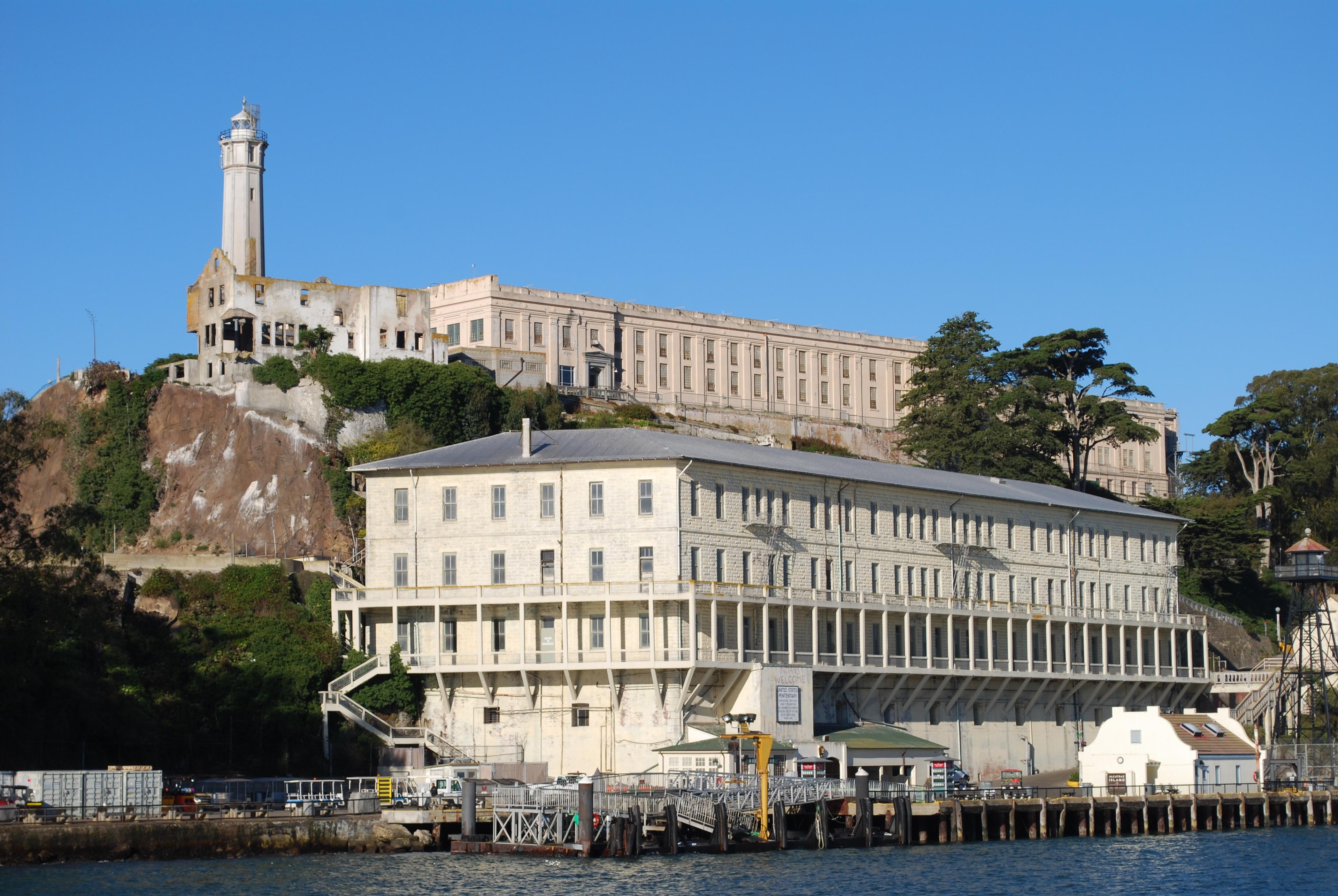
Kate Nevens · CC BY · via Wikimedia Commons
Why It Matters
Alcatraz Island in San Francisco Bay held one of the earliest U.S. military fortifications on the West Coast and, from 1934 to 1963, the federal government's most secure and notorious penitentiary. Its cold, isolating waters and reputation for escape-proof security made it a fixture of American popular culture.
The island later became the site of a 19-month occupation by Native American activists (1969–1971) that drew national attention to Indigenous rights. Today Alcatraz is one of the most visited National Park Service sites, reachable only by ferry.
The History
The U.S. Army built a fort and lighthouse on Alcatraz in the 1850s, taking advantage of the island's isolation and commanding position at the entrance to San Francisco Bay. The military later used it as a prison, first for Confederate sympathizers and deserters, then more broadly as a military stockade.
In 1934 the U.S. Department of Justice converted Alcatraz into a maximum-security federal penitentiary intended for the country's most difficult inmates, including Al Capone, George “Machine Gun” Kelly, and Robert Stroud (the “Birdman of Alcatraz”). Its cold currents and distance from shore contributed to its reputation as escape-proof, though at least a few attempts — most famously in 1962 — have never been conclusively solved.
Rising costs closed the penitentiary in 1963. From 1969 to 1971, the island was occupied by Native American activists asserting rights under 19th-century treaties, a protest that helped shape federal Indian policy. Alcatraz became part of the Golden Gate National Recreation Area in 1972 and opened to public tours in 1973.
Through the Years
- 1850s
The U.S. Army builds a fort and lighthouse on Alcatraz.
- 1934
Alcatraz opens as a federal maximum-security penitentiary.
- 1962
Three inmates vanish in a famous unsolved escape attempt.
- 1963
The federal penitentiary closes.
- 1969–1971
Native American activists occupy the island for 19 months.
- 1972
Alcatraz becomes part of the Golden Gate National Recreation Area.
- 1973
The island opens to the public for tours.
The Archive
 Plate 01Historic · 1926
Alcatraz Island, San Francisco Bay, California
Library of Congress · No known restrictions · via Library of Congress
 Plate 02
Alcatraz Island as seen from the East. The small island in the San Francisco Bay was developed with facilities for a lighthouse, a military fortification, and a prison.
Frank Schulenburg · CC BY-SA · via Wikimedia Commons
Facts & Figures
The Prison
- Federal penitentiary years
- 1934–1963
- Successful escapes
- None officially confirmed
- Notable inmates
- Al Capone, George “Machine Gun” Kelly, Robert Stroud
The Island
- Distance from San Francisco
- ~1.25 miles
The Register
- Established
- lighthouse/fort 1850s; federal penitentiary 1934
- Area of significance
- Military; Social History
Frequently Asked
Why was Alcatraz a prison?
Its isolation in San Francisco Bay and cold, fast-moving currents made it seem ideal for holding the federal prison system's most difficult inmates from 1934 to 1963.
Did anyone ever escape from Alcatraz?
No escape was ever officially confirmed as successful, though the fate of three inmates who vanished in a 1962 attempt has never been conclusively determined.
Who was held at Alcatraz?
Notable inmates included Al Capone, George “Machine Gun” Kelly, and Robert Stroud, the “Birdman of Alcatraz.”
Why did the Native American occupation happen?
From 1969 to 1971, Native American activists occupied Alcatraz to assert Indigenous rights and draw attention to broken treaties, a landmark protest in modern Native American history.
How do you get to Alcatraz?
Only by an official concessioner ferry from San Francisco's Pier 33; tickets should be booked well in advance.