National Park Service · Public domain · via Wikimedia Commons
We earn a commission if you book through the links below. How this works
For most of American history, a city's survival depended on the narrow channel where its river met the sea. Before coastal highways, railroads, or radar, an enemy fleet that forced a harbor mouth could burn a port or starve a colony. The response — begun by Spain, continued by the young republic, and expanded after the War of 1812 under the United States' "Third System" of coastal fortifications — was to build masonry strongholds on the islands, shoals, and peninsulas that commanded the narrows.
As artillery grew heavier in the late nineteenth century, those stone walls lost their military purpose, and the islands took on new lives: as monuments, immigrant inspection stations, military prisons, and federal penitentiaries. Six landmarks in the register trace that history across four centuries — and because most still sit across open water, visiting them begins, as it always did, at the dock.
St. Augustine, 1672: the shell-stone fortress
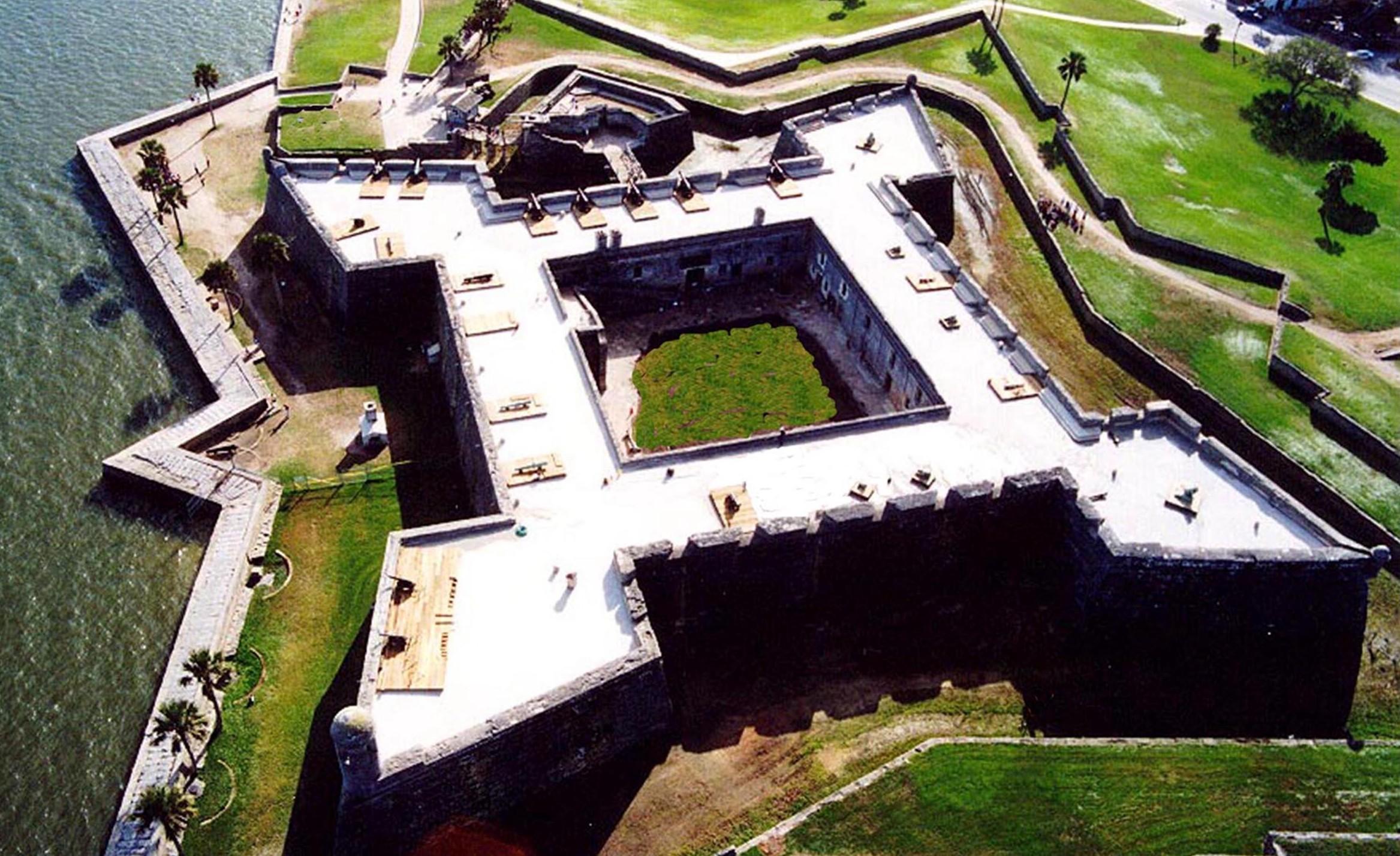
After the English privateer Robert Searles sacked St. Augustine in 1668, Spanish authorities decided that nine successive wooden forts had been enough. In 1672 they began quarrying coquina — a porous limestone formed from compressed seashells on nearby Anastasia Island — to raise the Castillo de San Marcos on the western shore of Matanzas Bay. Its core was completed in 1695, making it the oldest masonry fortification in the continental United States.
Coquina turned out to be an ideal material for the age of black-powder cannon. Rather than shattering under solid iron shot like brittle brick or granite, the soft shell-stone compressed and absorbed the impact, holding the ball like a wall of firm clay. When British forces under Georgia Governor James Oglethorpe besieged the fort for thirty-eight days in 1740, their bombardment pitted the walls without breaching them, and the Castillo was never taken in battle.
Baltimore Harbor, 1814: the star fort on Whetstone Point
Completed at the turn of the nineteenth century on a peninsula jutting into the Patapsco River, Fort McHenry was built as a five-pointed earthen and brick star fort to guard the water approach to Baltimore. Its test came during the War of 1812. On the morning of September 13, 1814, weeks after burning the public buildings of Washington, a British fleet began a twenty-five-hour bombardment of the fort with Congreve rockets and exploding mortar shells.
Major George Armistead, the fort's commander, had commissioned two flags the year before from the Baltimore flagmaker Mary Pickersgill, asking for "a flag so large that the British will have no difficulty in seeing it from a distance." At dawn on September 14, when the British guns fell silent and the smaller storm flag was replaced by the thirty-by-forty-two-foot garrison flag, the Maryland lawyer Francis Scott Key saw it from a truce ship downriver and began writing the poem that became "The Star-Spangled Banner."
Charleston Harbor, 1861: the artificial island in the channel
The War of 1812 exposed how easily foreign warships could enter American bays, prompting the federal government to ring its ports with multi-tiered brick forts. Beginning in 1829, army engineers dumped tens of thousands of tons of New England granite onto a shallow sandbar at the entrance to Charleston Harbor to create the foundation for Fort Sumter. Designed for 135 guns and five-foot-thick brick walls rising fifty feet above the water, the fort was still unfinished when South Carolina seceded in December 1860.
Six days after Christmas, Major Robert Anderson quietly moved his small Union garrison from the indefensible Fort Moultrie on the shore out to the island fort in the middle of the harbor. At 4:30 a.m. on April 12, 1861, Confederate batteries ringing the harbor opened fire. After thirty-four hours of shelling, Anderson surrendered the ruined fort — and four years of civil war began.
Liberty Island, 1886: a star fort becomes a pedestal
Long before Frédéric Auguste Bartholdi's copper colossus rose above New York Harbor, the twelve-acre island then called Bedloe's Island carried an eleven-pointed granite fortification: Fort Wood, completed in 1811 to defend the Upper Bay alongside Castle Williams on Governors Island and Castle Clinton at the Battery.
When Bartholdi visited New York in 1871 to choose a site for the Statue of Liberty, he saw immediately that every ship entering the narrows had to pass Bedloe's Island. Rather than demolishing Fort Wood, the American architect Richard Morris Hunt built the statue's eighty-nine-foot granite pedestal directly inside the courtyard of the old star-shaped walls — where the fort's stone points still frame the base today.
Ellis Island, 1892: from naval magazine to the Great Hall
Less than half a mile north of Liberty Island, Ellis Island was barely three acres of mud and oyster shells at high tide when New York fortified it in the 1790s as Fort Gibson and later used it as a U.S. Navy ordnance depot. Only after nearby residents objected to storing tons of gunpowder in the busy harbor did Congress repurpose the island for the country's first federal immigration station, which opened on January 1, 1892.
After the original timber buildings burned in 1897, the federal government rebuilt in fireproof brick and limestone, opening the vaulted Beaux-Arts Main Building in December 1900. Over the next five decades, using landfill excavated from New York's subways and ship channels, engineers expanded the island ninefold to 27.5 acres. By the time the station closed in 1954, more than twelve million immigrants had walked through its Registry Room.
San Francisco Bay, 1850–1963: the citadel under the cellhouse
Visitors boarding the ferry at Pier 33 know Alcatraz Island as the maximum-security federal penitentiary that held Al Capone, George "Machine Gun" Kelly, and Robert Stroud between 1934 and 1963. Yet the island's first eighty years under the United States flag belonged to the U.S. Army. Paired with the Presidio of San Francisco on the southern headland of the Golden Gate, Alcatraz was fortified in the 1850s with coastal cannon, a brick citadel, and the first operational lighthouse on the Pacific coast.
Because the frigid currents of San Francisco Bay made escape nearly impossible, the Army began holding military prisoners on the rock during the Civil War — including Confederate privateers and citizens accused of treason — and formally designated it the Pacific Branch of the U.S. Military Prison in 1907. When convicts built the concrete cellhouse that still crowns the island between 1909 and 1912, they constructed it directly atop the basement walls and cisterns of the 1850s Citadel, which can still be seen beneath the prison floor.
Planning a harbor crossing
Because waterborne landmarks depend on ferry capacities and harbor weather, they reward earlier planning than mainland sites. Morning departures almost always mean calmer water and shorter security lines at the dock, and staying within walking distance of the slip — in Lower Manhattan for Battery Park, downtown Charleston for Liberty Square, or Fisherman's Wharf for Pier 33 — turns an early boarding call into an easy walk along the waterfront.