- Spanish Colonial (1565–1763)
- 29.8975° N, 81.3113° W
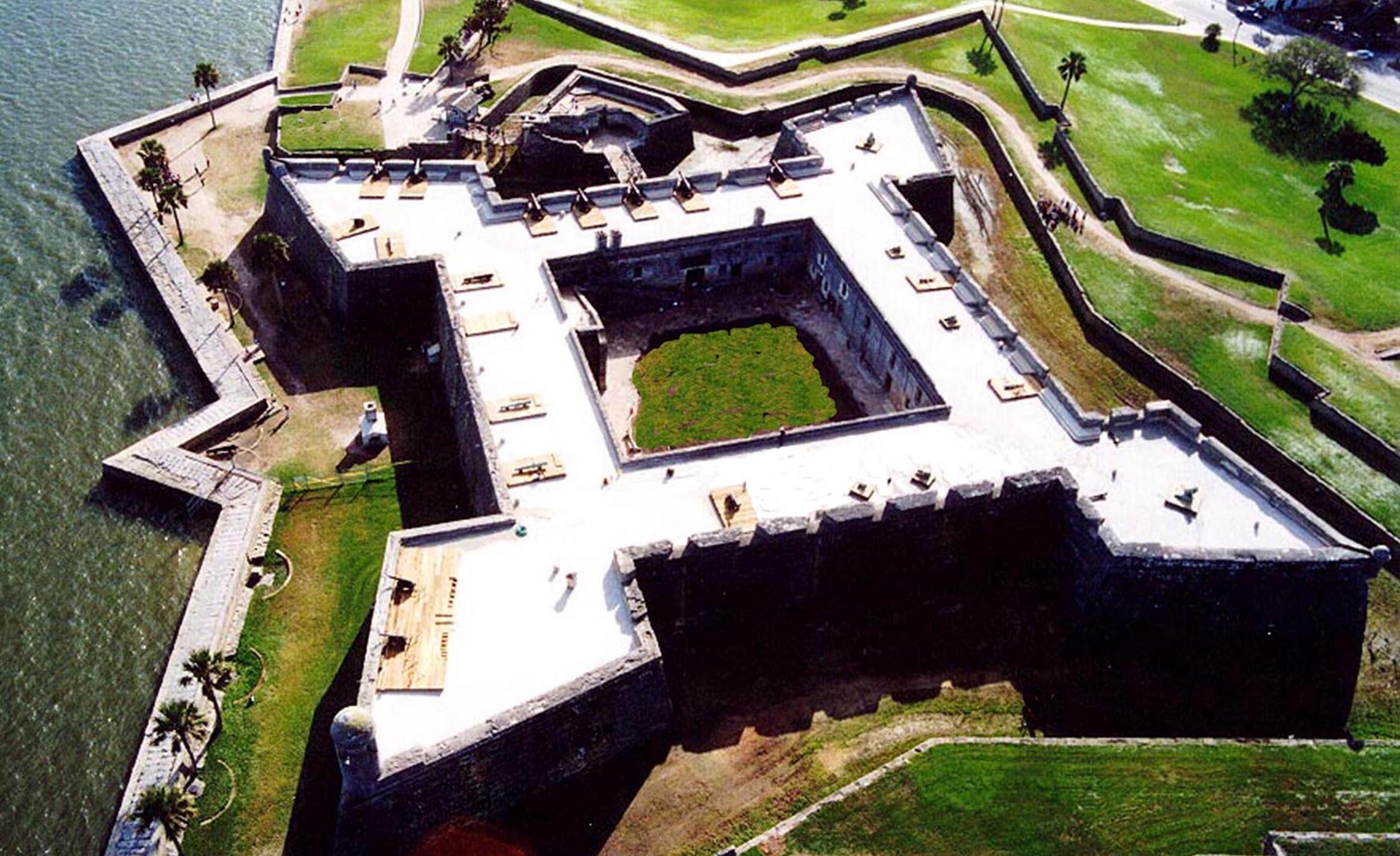
Castillo de San Marcos
St. Augustine, Florida · Established 1695
National Park Service · Public domain · via Wikimedia Commons
Why It Matters
Castillo de San Marcos is the oldest masonry fort in the continental United States, a Spanish stronghold that has guarded St. Augustine, Florida, since the 17th century. Built of coquina — a soft local shellstone that absorbed cannon fire rather than shattering — the star-shaped fortress was never taken by force in more than 250 years of sieges and changing flags. It stands today as the enduring symbol of Spain's long presence in early America.
The History
St. Augustine, founded by the Spanish in 1565, is the oldest continuously inhabited European settlement in the continental United States, but for a century it was defended only by a succession of wooden forts. After English raids exposed their weakness, Spain began building a permanent stone fortress in 1672. Completed in 1695, the Castillo de San Marcos was constructed from coquina, a soft limestone of compressed seashells quarried nearby on Anastasia Island.
That humble material proved remarkably effective: rather than shattering under bombardment, the porous coquina absorbed and trapped cannonballs. The fort withstood repeated attacks, including major English sieges led by James Moore in 1702 and Georgia's founder James Oglethorpe in 1740, and it was never taken by force. Control of the Castillo instead passed by treaty — to Britain in 1763, back to Spain in 1783, and finally to the United States in 1821.
Renamed Fort Marion by the Americans, the fortress later served as a military prison, holding Native American captives — among them Apache and Plains leaders — during the wars of the 1870s and 1880s. Its original Spanish name was restored in 1942. Designated a national monument in 1924 and administered by the National Park Service, the Castillo remains the oldest and best-preserved Spanish colonial fortification in the continental U.S.
Through the Years
- 1565
Spain founds St. Augustine, the oldest continuous European settlement in the continental U.S.
- 1672
Construction of the coquina Castillo de San Marcos begins.
- 1695
The fort is completed.
- 1702 & 1740
English sieges fail; the fort is never taken by force.
- 1763
Britain gains Florida and the fort by treaty; Spain regains it in 1783.
- 1821
The United States acquires Florida; the fort is renamed Fort Marion.
- 1924
Declared a national monument; the Spanish name is restored in 1942.
The Archive
 Plate 01
Crowd inside the Castillo de San Marcos National Monument
Kiran891 · CC BY-SA · via Wikimedia Commons
 Plate 02
Castillo de San Marcos Cannon
qwesy qwesy · CC BY · via Wikimedia Commons
 Plate 03
Crowd at ticket booth at Castillo de San Marcos National Monument
Kiran891 · CC BY-SA · via Wikimedia Commons
 Plate 04
View of three cannons on Castillo de San Marcos
Roman Eugeniusz · CC BY-SA · via Wikimedia Commons
 Plate 05
Front gate to Castillo de San Marcos National Monument
Macapplethorpe · CC BY-SA · via Wikimedia Commons
 Plate 06
In the center area of Castillo de San Marcos in St. Augustine, Florida.
Fredlyfish4 · CC BY-SA · via Wikimedia Commons
Facts & Figures
The Fort
- Built
- 1672-1695 by Spain
- Material
- Coquina (shellstone) from Anastasia Island
- Design
- Four-bastion star fort with a moat
- Distinction
- Oldest masonry fort in the continental U.S.
History
- Never
- Taken by force in 250+ years
Later use
- U.S. era
- Renamed Fort Marion; used as a military prison
Today
- Operator
- National Park Service
The Register
- Established
- 1695
- Architectural style
- Spanish colonial bastioned star fort
- Builder
- Spanish Empire (engineer Ignacio Daza)
- Area of significance
- Military — Spanish colonial
Frequently Asked
What is Castillo de San Marcos?
It is a 17th-century Spanish fort in St. Augustine, Florida, and the oldest masonry fortification in the continental United States. It was built to defend Spanish Florida and completed in 1695.
What is the fort made of?
It is built of coquina, a soft local limestone formed from compressed seashells. The porous stone absorbed cannonballs rather than shattering, which helped the fort survive repeated sieges.
Was Castillo de San Marcos ever captured?
Not by force. In more than 250 years the fort was never taken in battle; it changed hands only through treaties, passing between Spain, Britain, and finally the United States.
Can you visit Castillo de San Marcos?
Yes. It is a national monument in St. Augustine run by the National Park Service, with the gun deck, living quarters, and moat open to visitors, plus cannon-firing demonstrations.