- Gilded Age (1865–1900)
- 40.6995° N, 74.0396° W
Ellis Island
New York, New York · Established 1892 (opened)
Public domain · via Wikimedia Commons
Why It Matters
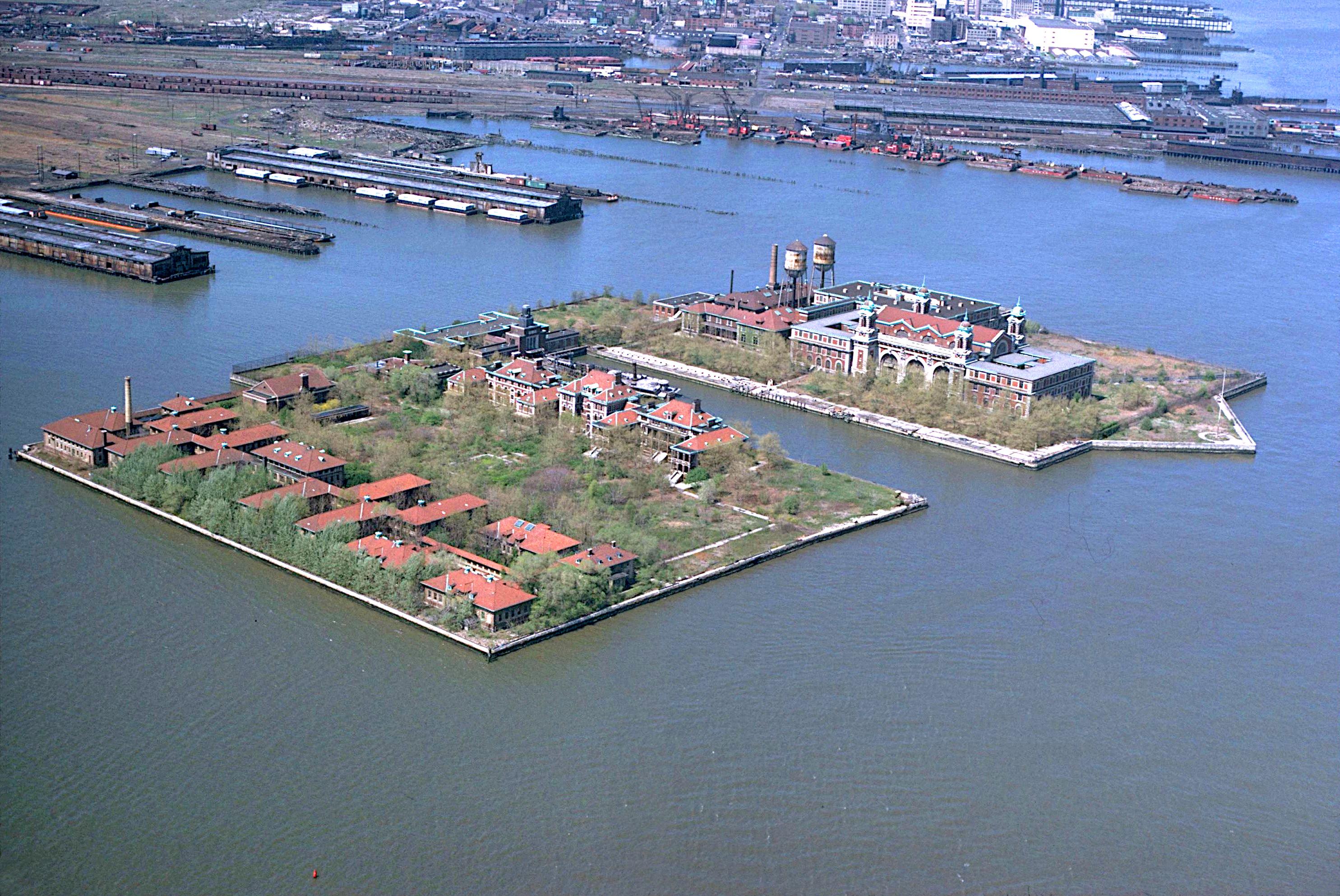
For more than six decades, Ellis Island in New York Harbor was the front door to America. From 1892 to 1954 it served as the nation's largest and busiest immigrant inspection station, where roughly 12 million people took their first steps as new arrivals to the United States.
An estimated 40% of Americans can trace an ancestor who passed through its Registry Room. Once nearly lost to neglect, the great hall and Main Building have been restored as the Ellis Island National Museum of Immigration, part of the Statue of Liberty National Monument.
The History
Ellis Island opened as a federal immigration station on January 1, 1892; the first person processed was Annie Moore, a teenager from Ireland. The original wooden buildings burned in 1897, and a new fireproof Main Building in the Beaux-Arts style — designed by the firm Boring & Tilton — opened in 1900.
At its peak the station processed extraordinary numbers of people; 1907 was its busiest year, with more than a million immigrants. Most passed through in a matter of hours, moving through the soaring Registry Room — the “Great Hall” — for medical and legal inspection. Some were detained, and a small fraction were turned back.
As immigration laws tightened in the 1920s the island's role declined, and it finally closed in 1954. After decades of neglect, the Main Building was restored and reopened in 1990 as a museum. Ellis Island is administered by the National Park Service as part of the Statue of Liberty National Monument.
Through the Years
- 1892
Ellis Island opens; Annie Moore is the first immigrant processed on January 1.
- 1897
Fire destroys the original wooden buildings.
- 1900
A new fireproof Beaux-Arts Main Building opens.
- 1907
The station's busiest year: more than one million immigrants processed.
- 1954
Ellis Island closes as an immigration station.
- 1990
The restored Main Building reopens as the Ellis Island Immigration Museum.
The Archive
 Plate 01
1st floor laboratory in Pharmacist’s house, Ellis Island.
NPS Photo · Public domain · via Wikimedia Commons
 Plate 02
A courtyard at Ellis Island
Magpieturtle · CC BY-SA · via Wikimedia Commons
 Plate 03
Detail of Ellis Island Immigration Museum, New York, New York
Carol M. Highsmith Archive, Library of Congress · No known restrictions · via Library of Congress
 Plate 04Historic · 1910
Old illustration of Ellis Island. New York City
Library of Congress · No known restrictions · via Library of Congress
Facts & Figures
By the Numbers
- Years in operation
- 1892–1954
- Immigrants processed
- ~12 million
- Main Building opened
- 1900
- Architectural style
- Beaux-Arts
The Register
- Established
- 1892 (opened)
- Builder
- Boring & Tilton (Main Building, 1900)
- Area of significance
- Social History; Immigration
Frequently Asked
What was Ellis Island?
The main U.S. immigration station from 1892 to 1954, where about 12 million immigrants were processed.
How many immigrants came through Ellis Island?
About 12 million over six decades of operation.
Who was the first immigrant processed there?
Annie Moore, a teenager from Ireland, on January 1, 1892 — the station's opening day.
Is Ellis Island connected to the Statue of Liberty?
Yes. Both are part of the Statue of Liberty National Monument, and the same ferry serves them.
Can you visit Ellis Island?
Yes. Ferries from Battery Park (New York) and Liberty State Park (New Jersey) reach the island, and the immigration museum is free to enter.