Christian David · CC BY-SA · via Wikimedia Commons
Between 1883 and 1892, three structures opened in and around New York Harbor that would come to stand for the city, and for much of the country. Each was a feat of its age. Together they made the harbor the place where millions of people first met America.
May 24, 1883: the bridge
When the Brooklyn Bridge opened on May 24, 1883, it was the first fixed crossing of the East River and, with a main span of about 1,595 feet, the longest suspension bridge in the world. It had taken more than a decade to build and cost the life of its designer, John A. Roebling, who died of an injury suffered while surveying the site before construction began. His son, Washington Roebling, took over as chief engineer; when he was left disabled by decompression sickness from work in the underwater caissons, his wife, Emily Warren Roebling, became essential to the project, carrying his instructions to the site and mastering its engineering herself.
October 28, 1886: the statue
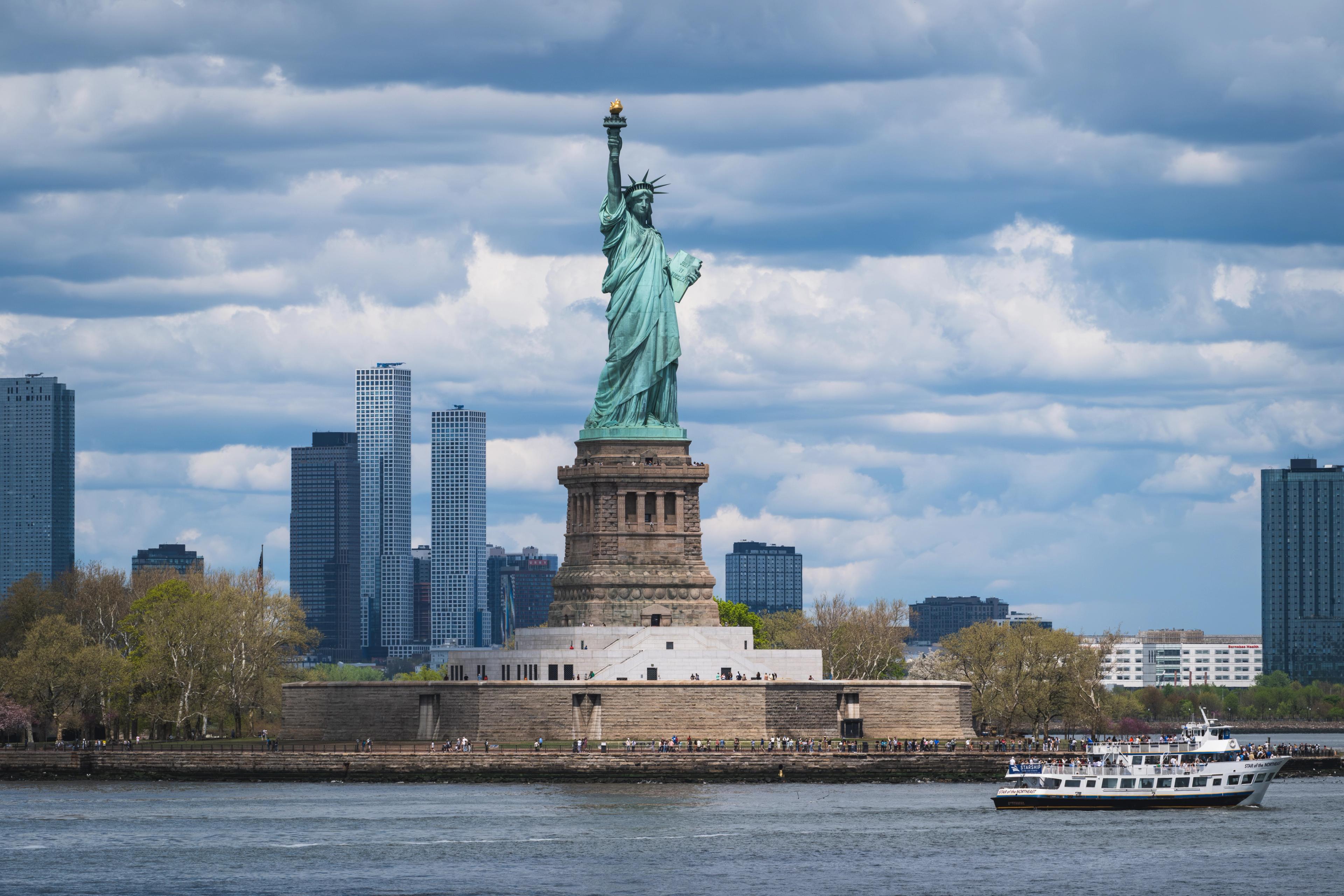
Three years later, a gift from the people of France was dedicated on an island in the upper harbor. The sculptor Frédéric Auguste Bartholdi designed the statue; Gustave Eiffel engineered the iron framework inside its copper skin. The pedestal was paid for by Americans, and fundraising was slow until the publisher Joseph Pulitzer used his newspaper, the New York World, to campaign for small donations. The Statue of Liberty was dedicated on October 28, 1886.
The poem now linked to it was written as part of that fundraising. In 1883 Emma Lazarus wrote a sonnet, "The New Colossus," for an auction to benefit the pedestal fund. It was largely forgotten until 1903, when it was engraved on a plaque and mounted inside the pedestal.
“Give me your tired, your poor, / Your huddled masses yearning to breathe free, / The wretched refuse of your teeming shore. / Send these, the homeless, tempest-tost to me, / I lift my lamp beside the golden door!”
January 1, 1892: the island
The federal immigration station on Ellis Island opened on January 1, 1892. Its first immigrant was Annie Moore, a seventeen-year-old from Cork, Ireland, traveling with her two brothers to join their parents. By the time the station closed in 1954, about twelve million immigrants had passed through it; by one estimate, some two-fifths of Americans may be descended from them.
The original wooden station burned in 1897; the grand brick building that visitors tour today, now the National Museum of Immigration, opened in 1900.
The three openings came within nine years of each other, at the height of the Gilded Age. A ferry from the Battery still carries visitors to Liberty Island and Ellis Island in a single trip, and the bridge is a short subway ride away — the whole story can be seen in a day.