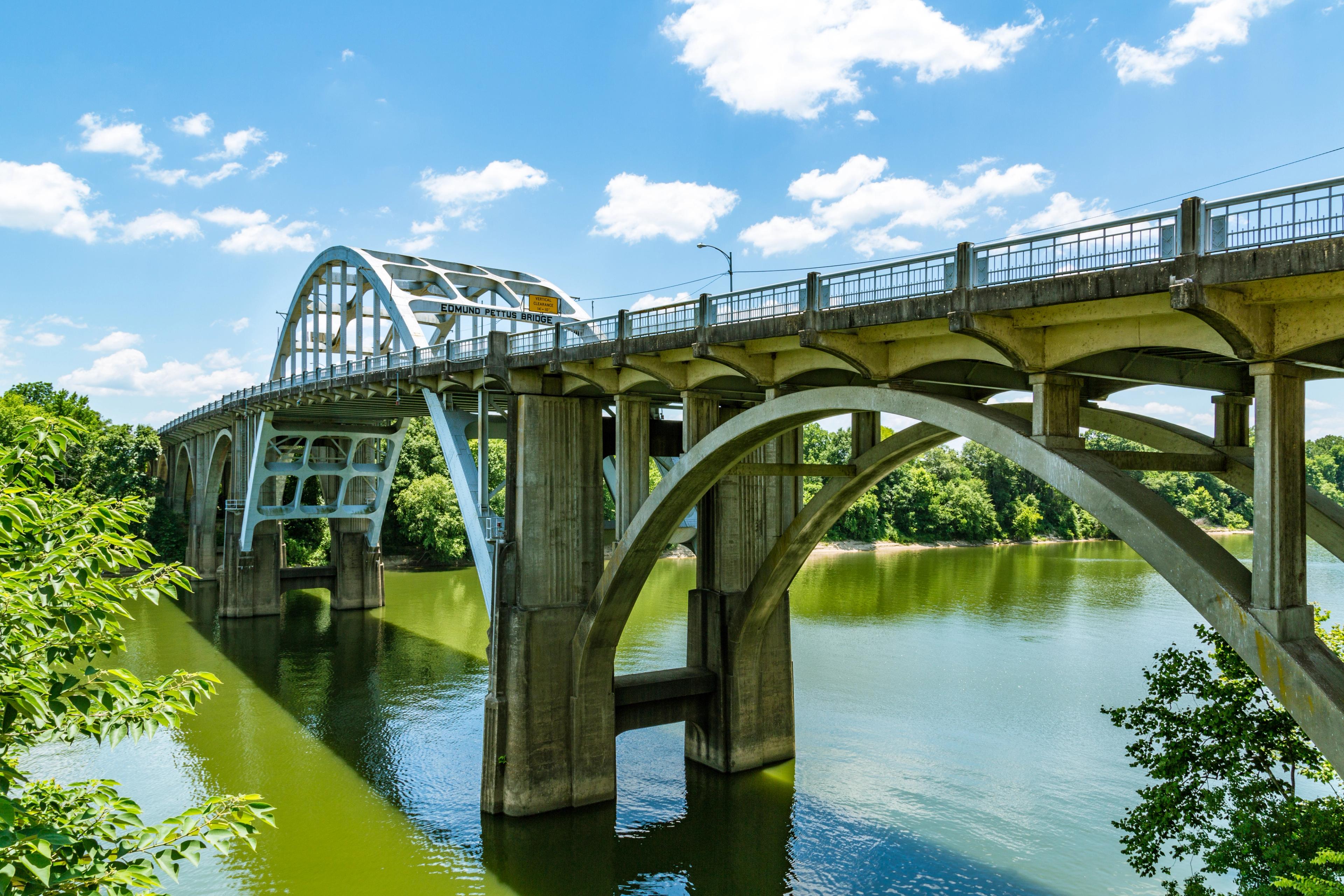
Tony Webster from Minneapolis, Minnesota, United States · CC BY-SA · via Wikimedia Commons
The civil rights movement was fought in courtrooms and legislatures, but it was won in public places — schools, streets, bridges and monuments — where ordinary people put themselves in front of the country. Five landmarks in the register mark some of its turning points.
Little Rock Central High School, 1957
Three years after the Supreme Court ruled segregated public schools unconstitutional, nine Black students enrolled at Little Rock Central High School in Arkansas. When classes began in September 1957, Governor Orval Faubus called out the Arkansas National Guard to keep them out. After weeks of confrontation and a mob outside the school, President Dwight D. Eisenhower federalized the Arkansas Guard and sent soldiers of the 101st Airborne Division, who escorted the students — the Little Rock Nine — into the school.
The school is still a working high school. Its visitor center, part of a National Historic Site, tells the story across the street.
The Lincoln Memorial, 1939 and 1963
The steps of the Lincoln Memorial became a civil rights stage long before the movement's peak. In 1939, after the Daughters of the American Revolution refused to let the contralto Marian Anderson sing to an integrated audience in Constitution Hall, she performed an open-air concert at the memorial on Easter Sunday, April 9, before a crowd of more than 75,000.
On August 28, 1963, the March on Washington for Jobs and Freedom filled the Mall, with estimates of the crowd ranging from 200,000 to 300,000. From the memorial's steps, Martin Luther King Jr. delivered the speech remembered by its refrain, "I have a dream." An inscription on the steps marks the spot where he stood.
The Edmund Pettus Bridge, 1965
In Selma, Alabama, where Black residents had been systematically kept from registering to vote, activists planned a march to the state capital at Montgomery. On Sunday, March 7, 1965, about 600 marchers led by John Lewis and Hosea Williams crossed the Edmund Pettus Bridge and were attacked by state troopers and county possemen with clubs and tear gas. Television carried the images of "Bloody Sunday" across the country.
Eight days later, President Lyndon B. Johnson went before Congress to ask for a voting rights law.
“Their cause must be our cause too. Because it is not just Negroes, but really it is all of us, who must overcome the crippling legacy of bigotry and injustice. And we shall overcome.”
The march to Montgomery was completed later that month under federal protection, and Johnson signed the Voting Rights Act on August 6, 1965.
Atlanta and Washington: King's places
Martin Luther King Jr. was born in 1929 in a house on Auburn Avenue in Atlanta. The Martin Luther King Jr. National Historical Park preserves his boyhood home and Ebenezer Baptist Church, where he was baptized and where he and his father were pastors, together with the tombs of King and his wife, the civil rights activist Coretta Scott King.
In Washington, the Martin Luther King Jr. Memorial opened in 2011. Its centerpiece, the "Stone of Hope," is a granite figure of King carved by the sculptor Lei Yixin, emerging from a split mountain of stone — an image drawn from a line of the 1963 speech: "Out of the mountain of despair, a stone of hope."
None of these places is only a monument. Each marks a moment when people took a risk in public, and the country had to decide what it would do about it.