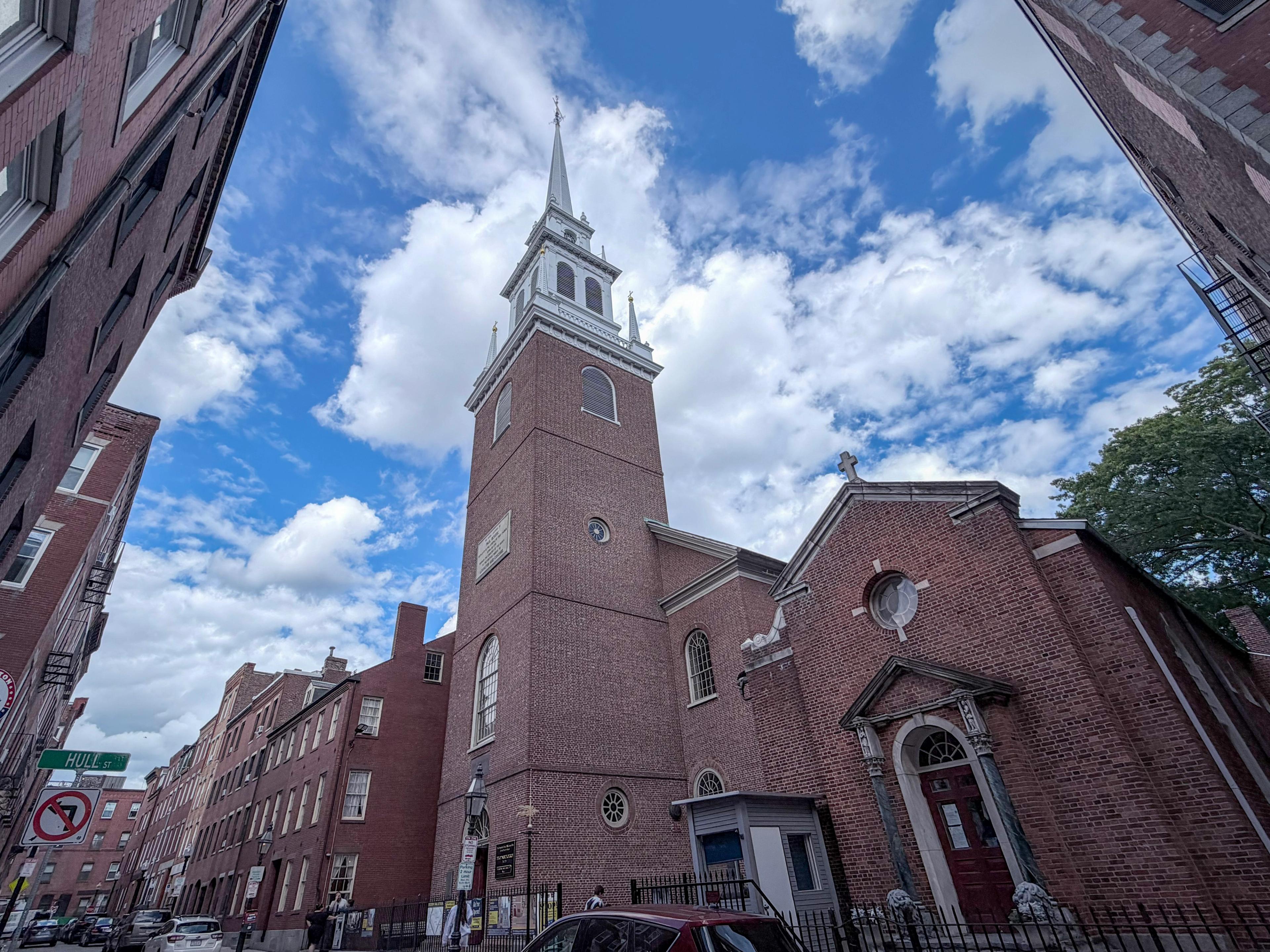
LEvalyn · CC BY · via Wikimedia Commons
Few cities let you walk a revolution the way Boston does. The buildings where colonists protested, fought and finally declared themselves independent stand within a mile or so of each other, and a red line in the pavement — the Freedom Trail — joins them. Conceived by the journalist William Schofield in 1951, it runs 2.5 miles past sixteen sites. Four of them tell the story of the years before the shooting started.
Faneuil Hall: the argument
Faneuil Hall opened in 1742 as a marketplace with a meeting hall above it, the gift of the merchant Peter Faneuil. It earned the name "the Cradle of Liberty" in the 1760s and 1770s, when Boston's town meetings gathered there to protest British taxes and to organize resistance to them. The building's history is more complicated than its nickname: Faneuil's fortune came in part from the trade in enslaved people, and the hall was funded in part by those profits.
The Old State House: the massacre and the balcony
Completed in 1713, the Old State House was the seat of Massachusetts' colonial government and is the city's oldest surviving public building. On March 5, 1770, British soldiers fired into a crowd just outside it, killing five men — the Boston Massacre, marked today by a circle of cobblestones near the building.
Six years later the same building closed the argument. On July 18, 1776, two weeks after the Declaration of Independence was adopted in Philadelphia, it was read to Bostonians from the Old State House balcony. The crowd tore down the lion and unicorn, the royal symbols on the roof, and burned them.
Old North Church: the signal
Old North Church, built in 1723, is Boston's oldest standing church, and its steeple is the city's most famous piece of signaling equipment. On the night of April 18, 1775, as British troops prepared to march on Lexington and Concord, two lanterns were hung in the steeple to warn the countryside that the soldiers were leaving by water, across the Charles River, rather than by land.
The Paul Revere House: the ride
The man who had arranged that signal lived a few streets away. The Paul Revere House, built no later than 1680, is the oldest remaining structure in downtown Boston; Revere, a silversmith, owned it from 1770 to 1800. The same night the lanterns were lit, he was rowed across the Charles and rode out to warn the patriot leaders Samuel Adams and John Hancock at Lexington that the British were coming.
Revere described the arrangement of the lanterns himself, years later, in a letter to the historian Jeremy Belknap. The rhyme most people remember — "one if by land, and two if by sea" — is not his: it comes from Henry Wadsworth Longfellow's poem "Paul Revere's Ride," published in 1860.
Walking it
The four buildings can be seen in a morning. The shooting that the lanterns anticipated began the next day, on the green at Lexington and at the North Bridge in Concord, and the war it started would not formally end for eight years.