- Revolutionary War (1775–1783)
- 42.3600° N, 71.0568° W
Faneuil Hall
Boston, Massachusetts · Established 1742
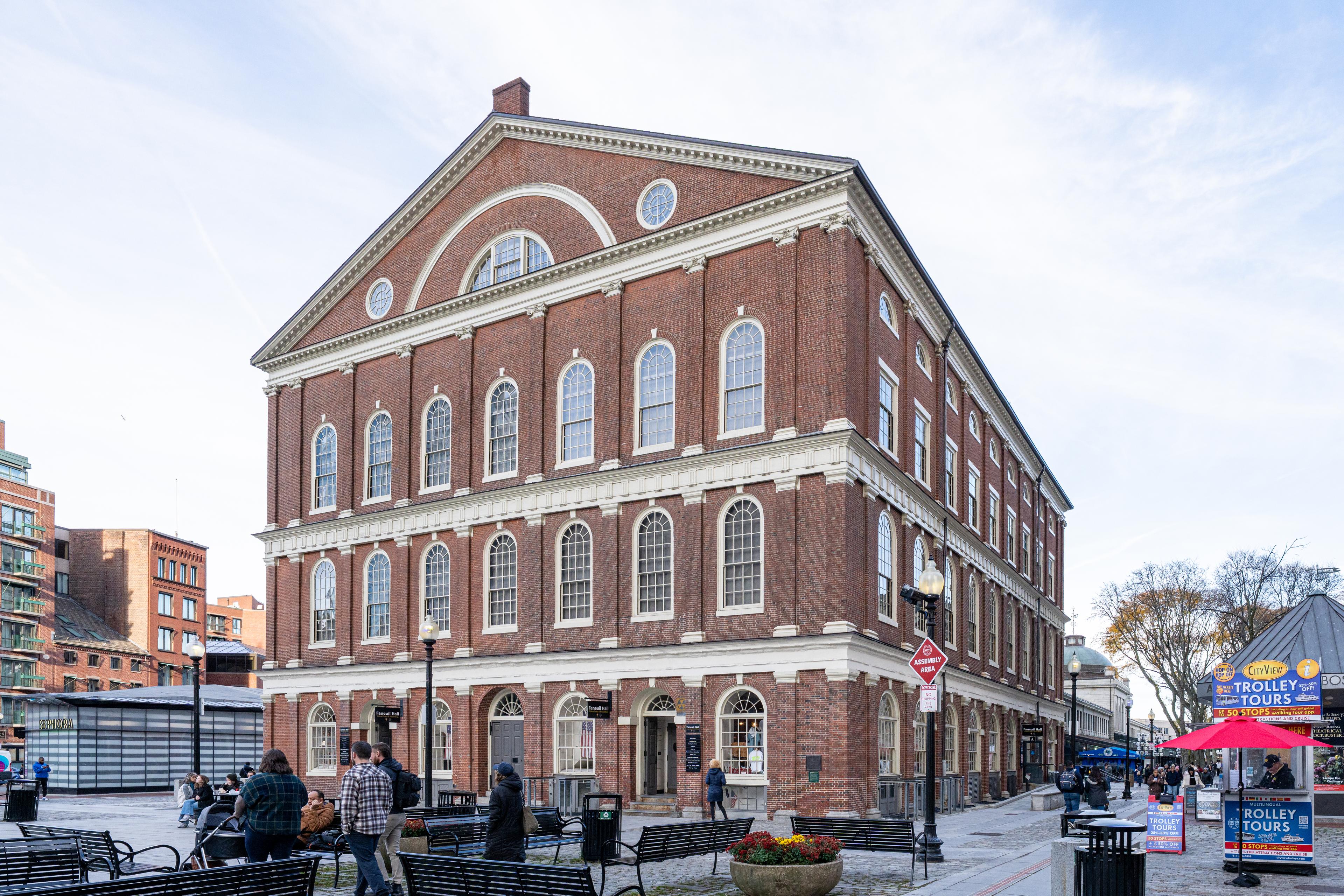
ajay_suresh · CC BY · via Wikimedia Commons
Why It Matters
Faneuil Hall has been called the 'Cradle of Liberty' for the fiery meetings that helped spark the American Revolution. Built as a public market and meeting hall and given to Boston by the merchant Peter Faneuil, its upstairs assembly room became the stage where Samuel Adams, James Otis, and other patriots denounced British taxation and rallied colonists toward independence. Nearly three centuries later it remains a working marketplace, a civic meeting place, and a centerpiece of Boston's Freedom Trail.
The History
The wealthy Boston merchant Peter Faneuil offered to build the town a central market house at his own expense, and the hall — designed by the painter John Smibert — was completed in 1742. Faneuil died soon after, and the building was named in his honor. It combined a ground-floor marketplace with a large meeting hall above, a pairing that would shape its role in the decades to come.
In the years before the Revolution, that meeting hall became a forum for protest. Here Samuel Adams, James Otis, and others rallied Bostonians against the Sugar Act, the Stamp Act, and 'taxation without representation,' earning Faneuil Hall its enduring nickname, the Cradle of Liberty. Fire gutted the building in 1761, but it was rebuilt by 1762 and the meetings resumed.
In 1805-1806 the architect Charles Bulfinch greatly enlarged the hall, doubling its width and adding a third story while keeping its Georgian character and the famous grasshopper weathervane crafted by Shem Drowne in 1742. Faneuil Hall went on to host debates over abolition, women's suffrage, and other causes. Today it is part of Boston National Historical Park and the Freedom Trail, still ringed by market stalls and still used for public gatherings.
Through the Years
- 1742
Faneuil Hall is completed to John Smibert's design.
- 1743
The finished hall is presented to the town of Boston.
- 1761
Fire destroys the interior; it is rebuilt by 1762.
- 1760s-70s
Patriots hold revolutionary protest meetings in the hall.
- 1806
Charles Bulfinch enlarges the hall to its present size.
- 1974
Becomes part of the newly created Boston National Historical Park.
The Archive
 Plate 01
Interior of Faneuil Hall, Boston
Crisco 1492 · CC BY-SA · via Wikimedia Commons
 Plate 02
Faneuil Hall sign, Boston, Mass
Victorgrigas · CC BY-SA · via Wikimedia Commons
 Plate 03
Faneuil Hall, Boston, in the Evening
Tony the Misfit · CC BY-SA · via Wikimedia Commons
 Plate 04
Statue of Samuel Adams in front of Faneuil Hall
Ingfbruno · CC BY-SA · via Wikimedia Commons
Facts & Figures
The Building
- Benefactor
- Peter Faneuil
- Designed by
- John Smibert (1742); enlarged by Charles Bulfinch (1806)
- Style
- Georgian
- Nickname
- The Cradle of Liberty
Landmark detail
- Weathervane
- Grasshopper by Shem Drowne, 1742
Today
- Part of
- Boston National Historical Park & the Freedom Trail
The Register
- Established
- 1742
- Builder
- Peter Faneuil (benefactor); John Smibert (architect)
- Area of significance
- Politics & Commerce (Revolutionary era)
- County
- Suffolk
- Acreage
- 0.9 acres
- National Register ref.
- 66000368
- Listed on the Register
- October 15, 1966
- National Historic Landmark
- October 9, 1960
Frequently Asked
Why is Faneuil Hall called the Cradle of Liberty?
Its upstairs meeting hall hosted fiery protests against British taxation in the 1760s and 1770s, led by Samuel Adams and others, helping to spark the American Revolution.
Who built Faneuil Hall?
It was funded by the Boston merchant Peter Faneuil and designed by the painter John Smibert, opening in 1742. Architect Charles Bulfinch later enlarged it in 1805-1806.
Can you visit Faneuil Hall?
Yes. Faneuil Hall is part of Boston National Historical Park and the Freedom Trail. Visitors can see the historic meeting hall upstairs, and the ground floor is still a marketplace.
Is Faneuil Hall still used today?
Yes. It remains a public meeting place and marketplace and is a major stop on Boston's Freedom Trail, alongside the adjacent Quincy Market.