- Colonial America (1607–1775)
- 42.3638° N, 71.0537° W
Paul Revere House
Boston, Massachusetts · Established 1680
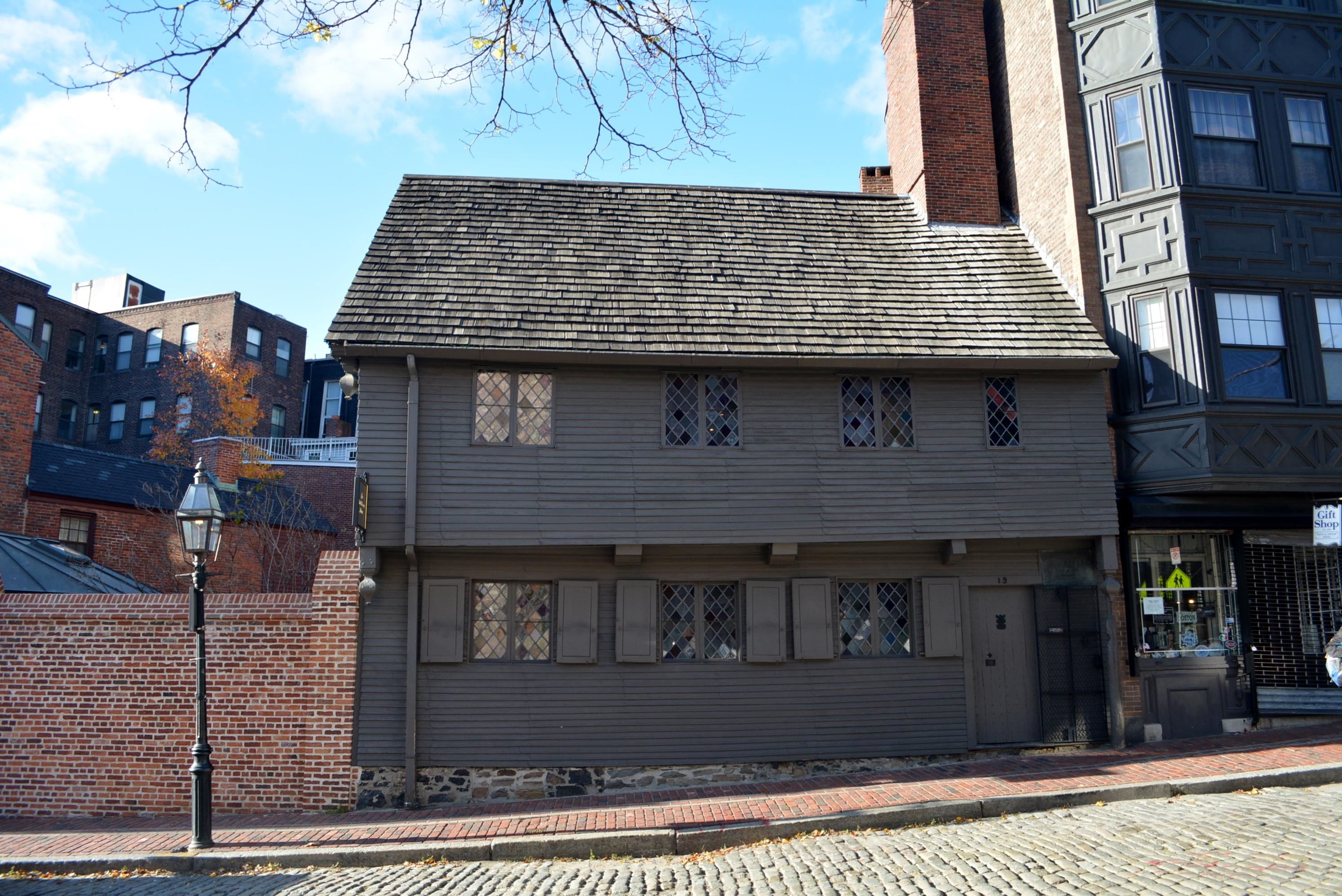
Elvis Boaventura · CC BY · via Wikimedia Commons
Why It Matters
The Paul Revere House is the colonial home from which the silversmith and patriot Paul Revere set out on his famous midnight ride in April 1775. Built around 1680, it is the oldest surviving building in downtown Boston and a rare example of 17th-century urban architecture in America. Preserved as one of the nation's earliest historic house museums, it offers an intimate look at the home life of a Revolutionary-era craftsman and the family he raised in Boston's North End.
The History
The house on North Square was built around 1680, on land where an earlier dwelling had burned in a great fire of 1676. A timber-framed structure in the medieval-derived style of the 17th century, it stood for nearly a century before Paul Revere — a Boston silversmith, engraver, and son of a French Huguenot immigrant — bought it in 1770.
Revere lived here through the most dramatic years of the Revolution. It was from this house that he departed on the night of April 18, 1775, for the midnight ride that warned the countryside British troops were marching on Lexington and Concord. Revere owned the home until 1800, raising a large family within its small rooms; he fathered sixteen children over the course of two marriages.
After the Revere family left, the North End filled with immigrants and the old house was crowded with shops and tenants. Threatened with demolition around the turn of the 20th century, it was rescued by Revere's great-grandson and a group of preservationists, restored, and opened to the public in 1908 as one of the first historic house museums in the United States. It remains a centerpiece of Boston's Freedom Trail.
Through the Years
- 1676
A fire clears the North Square site of an earlier house.
- 1680
The present house is built, in 17th-century timber-frame style.
- 1770
Paul Revere buys the house and moves his family in.
- 1775
Revere departs from here on his midnight ride, April 18.
- 1800
Revere sells the house.
- 1908
Restored and opened as one of America's first house museums.
The Archive
 Plate 01
Bell made at Paul Revere and Sons foundry in 1804, now on the grounds of Paul Revere House
lovinkat · CC BY · via Wikimedia Commons
 Plate 02
Back of Paul Revere's restored house
MamaGeek at en.wikipedia · CC BY-SA · via Wikimedia Commons
 Plate 03
Sidewalk in front of Paul Revere House
Andrzej Kotarski · CC BY · via Wikimedia Commons
Facts & Figures
The House
- Built
- c. 1680
- Distinction
- Oldest surviving building in downtown Boston
- Style
- 17th-century timber frame (First Period)
Paul Revere
- Owned
- 1770–1800
- Family
- Father of 16 children by two wives
Today
- Operator
- Paul Revere Memorial Association
The Register
- Established
- 1680
- Architectural style
- 17th-century colonial (First Period)
- Area of significance
- American Revolution & Colonial life
- County
- Suffolk
- Acreage
- 0.9 acres
- National Register ref.
- 66000785
- Listed on the Register
- October 15, 1966
- National Historic Landmark
- January 20, 1961
Frequently Asked
Who lived in the Paul Revere House?
The silversmith and Revolutionary patriot Paul Revere owned and lived in the house from 1770 to 1800, together with his large family. He set out from here on his famous midnight ride in 1775.
How old is the Paul Revere House?
It was built around 1680, making it the oldest surviving building in downtown Boston and one of the oldest houses in the United States.
Can you visit the Paul Revere House?
Yes. It operates as a historic house museum in Boston's North End, along the Freedom Trail, with rooms furnished to reflect Revere's era.
Did Paul Revere start his midnight ride here?
Yes. On the night of April 18, 1775, Revere left this house to be rowed across the Charles River and begin the ride that warned of the British advance on Lexington and Concord.