- UNESCO World Heritage Site (1987)
- Early Republic (1783–1815)
- 38.0081° N, 78.4530° W
Monticello
Charlottesville, Virginia · Built and remodeled 1769–1809
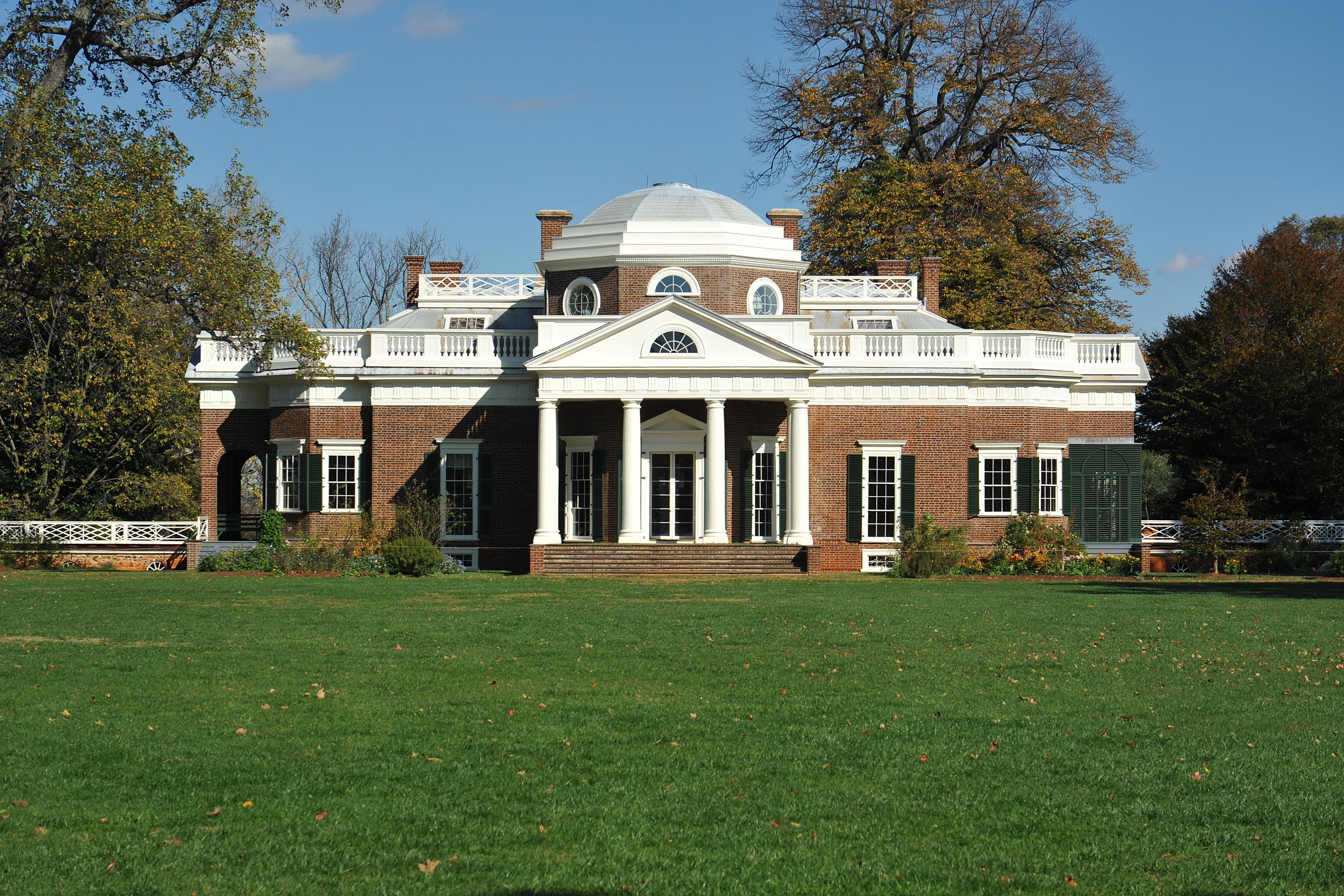
YF12s · CC BY-SA · via Wikimedia Commons
Why It Matters
Monticello was the mountaintop home of Thomas Jefferson — author of the Declaration of Independence and third President of the United States — which he designed himself and reworked over some forty years. A masterpiece of American neoclassical architecture, it reflects Jefferson's restless mind for design, science, and invention.
Monticello was also a working plantation dependent on the labor of enslaved people, a history the site now interprets in depth along Mulberry Row. Preserved by the Thomas Jefferson Foundation and named a UNESCO World Heritage Site, it appears on the reverse of the U.S. nickel.
The History
Jefferson began leveling the top of an 850-foot hill he called Monticello — Italian for “little mountain” — and started building in 1769. The first version of the house drew on the Palladian designs he admired in architectural books.
After serving as U.S. minister to France in the 1780s, Jefferson returned with new ideas and largely rebuilt Monticello between 1796 and 1809, adding the distinctive dome and expanding it to 43 rooms filled with his inventions and collections. The estate was run on the labor of enslaved men, women, and children, including members of the Hemings family.
Jefferson died at Monticello on July 4, 1826 — the fiftieth anniversary of the Declaration of Independence — and is buried in the family cemetery on the grounds. Deeply in debt, his heirs sold the estate; the Thomas Jefferson Foundation acquired it in 1923 and has preserved it since, and in 1987 it was named a UNESCO World Heritage Site.
Through the Years
- 1769
Jefferson begins building Monticello atop his “little mountain.”
- 1784–1789
Jefferson serves as U.S. minister to France, absorbing new architectural ideas.
- 1796–1809
Jefferson largely rebuilds Monticello into its domed, 43-room form.
- 1826
Thomas Jefferson dies at Monticello on July 4.
- 1923
The Thomas Jefferson Foundation acquires Monticello.
- 1987
Monticello is designated a UNESCO World Heritage Site.
The Archive
 Plate 01
A couple walking down the path behind Monticello.
Ginger Hannah · CC BY-SA · via Wikimedia Commons
 Plate 02
Backside of Monticello from the gardens
Queerbubbles · CC BY-SA · via Wikimedia Commons
 Plate 03
Monticello, VA - reconstructed kitchen
MPSharwood · CC BY-SA · via Wikimedia Commons
 Plate 04Historic · 1906
Monticello, Charlottesville, Virginia
Library of Congress · No known restrictions · via Library of Congress
Facts & Figures
The House
- Designer
- Thomas Jefferson
- Architectural style
- Neoclassical / Palladian
- Rooms
- 43
In Culture
- On the U.S. nickel
- Reverse of the five-cent coin
The Register
- Established
- built and remodeled 1769–1809
- Builder
- Thomas Jefferson (self-designed)
- Area of significance
- Architecture; Politics/Government
- County
- Albemarle
- Acreage
- 1,676 acres
- National Register ref.
- 66000826
- Listed on the Register
- October 15, 1966
- National Historic Landmark
- December 19, 1960
Frequently Asked
Who designed Monticello?
Thomas Jefferson designed it himself, reworking the plans over some forty years.
Is Thomas Jefferson buried at Monticello?
Yes. He is buried in the family cemetery on the grounds, where he died on July 4, 1826.
Is Monticello on a coin?
Yes. It appears on the reverse of the U.S. five-cent coin, the nickel.
Were enslaved people held at Monticello?
Yes. Monticello was a plantation dependent on enslaved labor; Jefferson enslaved hundreds of people, and the site interprets their lives, including the Hemings family, along Mulberry Row.
Can you visit Monticello?
Yes. It is open for ticketed tours daily, just outside Charlottesville, Virginia.