- The 20th Century (1900–2000)
- 38.8814° N, 77.0365° W
Jefferson Memorial
Washington, District of Columbia · Established 1943
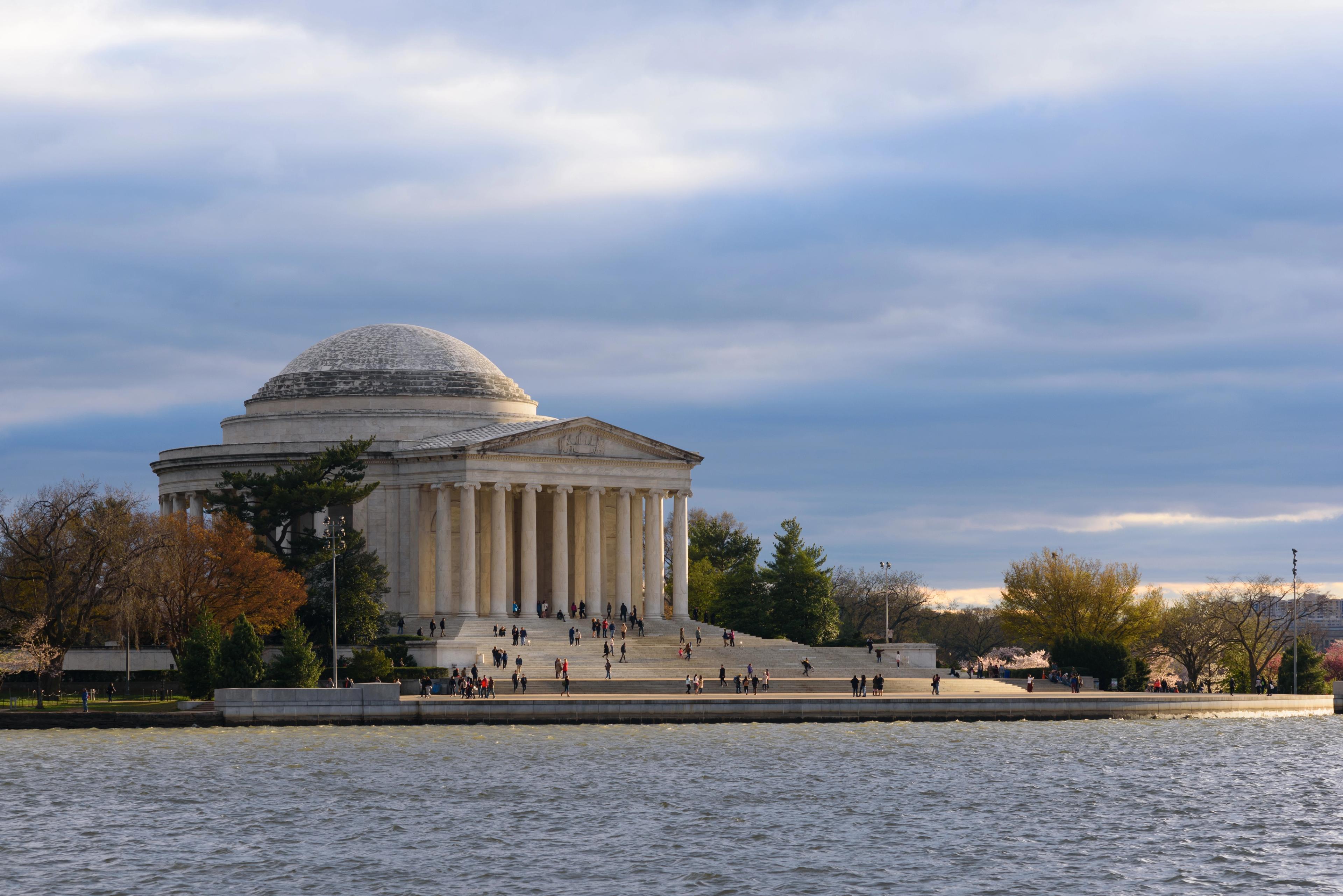
King of Hearts · CC BY-SA · via Wikimedia Commons
Why It Matters
The Jefferson Memorial is the only presidential memorial modeled on a building its subject actually designed himself — a fitting tribute to the architect-president whose own words on liberty and religious freedom are carved into its walls.
The History
Congress authorized a memorial to Thomas Jefferson in 1934, and architect John Russell Pope — who also designed the National Gallery of Art's West Building — was selected to design it in 1937, the same year he died. Pope modeled the memorial on the ancient Roman Pantheon and, more pointedly, on the domed Rotunda Jefferson had designed himself at the University of Virginia, giving the building a direct architectural link to its subject rather than a generic classical form.
Construction beginning in 1938 required removing a number of Japanese cherry trees planted along the Tidal Basin as a 1912 gift from Tokyo, and in 1938 a group of demonstrators, including several prominent Washington women, chained themselves to the trees in protest — an episode remembered as the 'Cherry Tree Rebellion.' The memorial was dedicated on April 13, 1943, Jefferson's 200th birthday, but wartime metal restrictions meant the ceremony featured only a plaster model of the planned statue, painted to resemble bronze.
Sculptor Rudulph Evans's 19-foot bronze statue of Jefferson was finally cast and installed in 1947, completing the memorial as it stands today. Its interior walls are inscribed with Jefferson's own writing — passages from the Declaration of Independence, the Virginia Statute for Religious Freedom, and his letters on government and liberty — turning the building itself into a monument to his ideas rather than only his likeness.
Through the Years
- 1934
Congress authorizes the Thomas Jefferson Memorial Commission
- 1937
John Russell Pope is selected as architect; he dies later that year
- 1938
Construction begins; the 'Cherry Tree Rebellion' protests the removal of Tidal Basin cherry trees
- 1943
The memorial is dedicated on Jefferson's 200th birthday, with a plaster statue standing in for the bronze
- 1947
Rudulph Evans's 19-foot bronze statue of Jefferson is installed
The Archive
 Plate 01
People visit the Thomas Jefferson Memorial in Washington, D.C., USA.
European Union · CC BY · via Wikimedia Commons
Facts & Figures
Architecture
- Architect
- John Russell Pope (also designed the National Gallery of Art West Building)
- Style
- Neoclassical, modeled on the Pantheon and Jefferson's own Rotunda at the University of Virginia
Art
- Statue
- 19-foot bronze by Rudulph Evans, installed 1947
Founding
- Dedication date
- April 13, 1943 — Jefferson's 200th birthday
Interior
- Inscriptions
- Excerpts from the Declaration of Independence, the Virginia Statute for Religious Freedom, and Jefferson's letters
History
- Cherry Tree Rebellion
- In 1938, protesters chained themselves to cherry trees slated for removal during construction
Site
- Setting
- On the Tidal Basin, ringed by Japanese cherry trees gifted by Tokyo in 1912
The Register
- Established
- 1943
- Architectural style
- Neoclassical
- Builder
- John Russell Pope (architect); statue by Rudulph Evans
- Area of significance
- Architecture, Political History
Frequently Asked
Why does the Jefferson Memorial look like the Pantheon?
Architect John Russell Pope modeled it on the ancient Roman Pantheon and on Jefferson's own domed Rotunda at the University of Virginia, reflecting Jefferson's own taste in classical architecture.
Why was there a protest during construction?
In 1938, demonstrators including several prominent Washington women chained themselves to cherry trees along the Tidal Basin that were to be removed for the memorial, in what became known as the 'Cherry Tree Rebellion.'
Is the statue of Jefferson original to the 1943 dedication?
No. Wartime metal shortages meant the 1943 dedication featured a plaster stand-in painted to resemble bronze; the actual 19-foot bronze statue by Rudulph Evans wasn't installed until 1947.
What quotes are inscribed inside the memorial?
Passages from the Declaration of Independence, the Virginia Statute for Religious Freedom, and Jefferson's letters on liberty and government line the interior walls.