YF12s · CC BY-SA · via Wikimedia Commons
Three of the first four presidents of the United States came home to plantations in Virginia. The houses they built are among the most visited historic homes in the country. Each tells two stories at once: of the men who shaped the new republic, and of the enslaved men, women and children whose labor paid for it.
Mount Vernon
George Washington's estate on the Potomac was his home for some forty years, through two wars and two terms as president. He enlarged the house, redesigned the grounds and ran the plantation as a business in close detail, even from a distance. He died at Mount Vernon in December 1799.
In 1799, 317 enslaved people lived on the estate. Fewer than half — 123 — belonged to Washington himself; most of the rest were "dower" slaves, the property of the estate of Martha Washington's first husband, whom Washington could not legally free. In his will he provided for the people he did own.
“Upon the decease of my wife, it is my will and desire, that all the slaves which I hold in my own right shall receive their freedom.”
Martha Washington freed them early, at the start of 1801. The dower slaves were not freed, and passed to her heirs.
Monticello
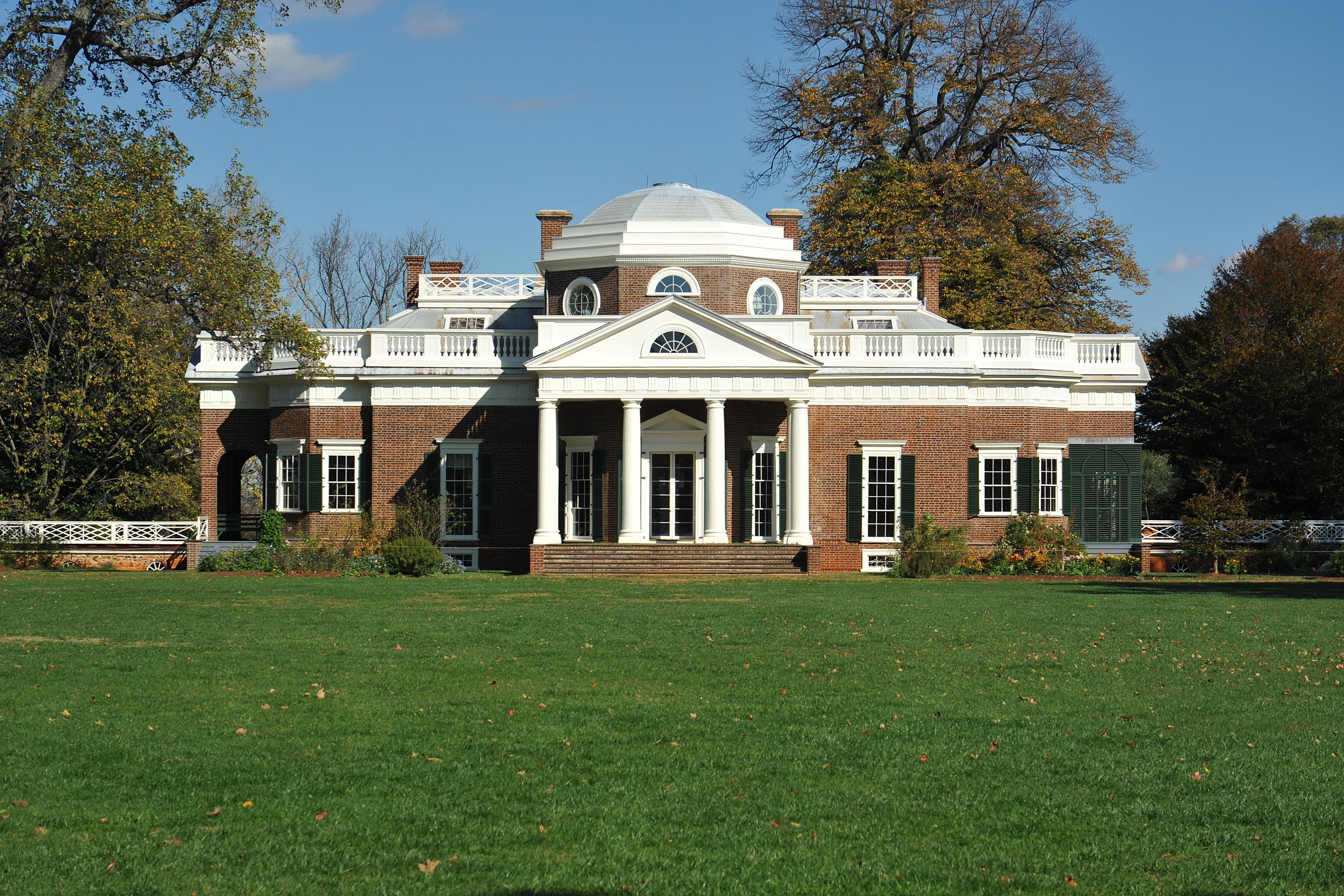
Thomas Jefferson began building Monticello on his mountaintop outside Charlottesville in 1768 and spent much of the rest of his life reworking it, tearing down and rebuilding to his own designs. The house, with the University of Virginia he also designed, was named a UNESCO World Heritage Site in 1987.
The author of the declaration that "all men are created equal" relied on the forced labor of enslaved people throughout his life, at Monticello and across his other lands, to build the house and work the plantation. Today the site presents that history directly: its tours and exhibits tell the stories of the families who were enslaved there, among them the Hemingses.
Montpelier
James Madison's home, Montpelier, lies about thirty miles northeast of Monticello, in Orange County. Madison — remembered as the father of the Constitution — spent the years before the 1787 Philadelphia convention studying the histories of earlier republics and confederacies, and later retired here with his wife, Dolley.
Montpelier, like Mount Vernon and Monticello, was a plantation worked by enslaved people. Since 1984 it has been owned by the National Trust for Historic Preservation. Archaeology in this century has uncovered the South Yard, where enslaved families lived, and its reconstructed dwellings are now part of every visit. In 2021 the foundation that runs Montpelier agreed to share its governance with a committee of descendants of the people enslaved there.
The three houses are monuments to what their owners achieved. Visited together, they are also one of the clearest places to understand the contradiction at the country's founding: liberty proclaimed by men who held others in slavery.