- Civil War (1861–1865)
- 32.3403° N, 90.8467° W
Vicksburg National Military Park
Vicksburg, Mississippi · Established 1863
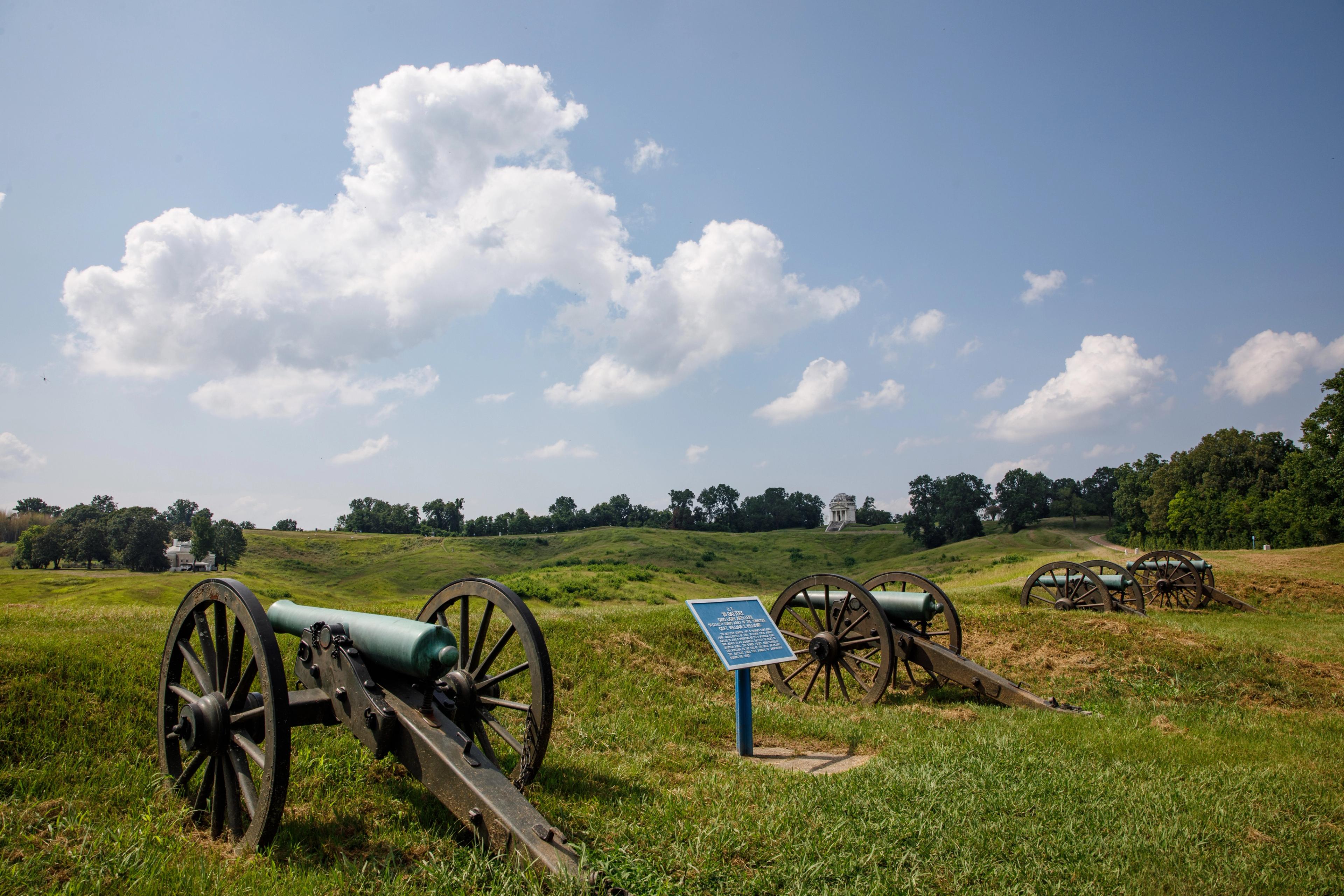
NPS · Public domain · via Wikimedia Commons
Why It Matters
Vicksburg was the key that unlocked the Confederacy. Perched on bluffs commanding a hairpin bend of the Mississippi, the 'Gibraltar of the Confederacy' controlled the river that was the South's lifeline. When Ulysses S. Grant took it after a grinding 47-day siege — on July 4, 1863, the day after Lee's defeat at Gettysburg — the Union split the Confederacy in two and gained the whole length of the Mississippi. Together with Gettysburg, it marked the great turning point of the Civil War.
The History
Through the spring of 1863 Grant maneuvered his army across the Mississippi and drove inland, winning a string of battles that pinned Confederate Lt. Gen. John C. Pemberton inside Vicksburg's formidable fortifications. On May 19 and again on May 22, Union troops hurled themselves at the works and were bloodily repulsed. Rather than bleed his army white, Grant settled in to starve the city out.
For 47 days Union guns and mortars pounded Vicksburg around the clock. Soldiers and civilians alike burrowed caves into the yellow bluffs to escape the shelling, and as food ran out the defenders ate mules, horses, and even rats. Sickness and hunger did what assaults could not. On July 4, 1863, Pemberton surrendered his army of roughly 29,000 men — one of the largest capitulations of the war.
With Vicksburg fallen and Port Hudson soon after, the Union controlled the entire Mississippi River. President Lincoln declared that 'the Father of Waters again goes unvexed to the sea.' The victory cemented Grant's reputation and helped carry him to overall Union command. In 1899 Congress established Vicksburg National Military Park, today marked by more than 1,300 monuments and the recovered ironclad gunboat USS Cairo.
Through the Years
- 1863
Grant crosses the Mississippi and drives on Vicksburg in the spring
- 1863
Union assaults on May 19 and 22 are repulsed; Grant lays siege
- 1863
Trapped civilians shelter in bluff caves under constant bombardment
- 1863
Pemberton surrenders roughly 29,000 troops on July 4
- 1863
The Union gains control of the entire Mississippi River
- 1899
Vicksburg National Military Park is established
- 1964
The ironclad USS Cairo is raised from the Yazoo River
The Archive
 Plate 01
Battlefield Arch in Vicksburg National Military Park.
Gary Todd from Xinzheng, China · CC0 · via Wikimedia Commons
 Plate 02
Equestrian Statue of General Grant in Vicksburg National Military Park.
Gary Todd from Xinzheng, China · CC0 · via Wikimedia Commons
 Plate 03
Minnesota State Memorial in Vicksburg National Military Park.
www.mgaylard.co.uk and thanks for looking · CC BY · via Wikimedia Commons
 Plate 04
Memorial Monument to African-American Veterans in Vicksburg National Military Park.
NPS · Public domain · via Wikimedia Commons
Facts & Figures
History
- Siege
- May 18 – July 4, 1863
- Union commander
- Maj. Gen. Ulysses S. Grant
- Confederate commander
- Lt. Gen. John C. Pemberton
- Surrender
- July 4, 1863 (~29,000 troops)
Significance
- Nickname
- 'Gibraltar of the Confederacy'
Site
- Monuments
- 1,300+ monuments & markers
- Ironclad
- USS Cairo (raised 1964)
The Register
- Established
- 1863
- Area of significance
- Military; Civil War
Frequently Asked
What was the Siege of Vicksburg?
It was Grant's 47-day siege in 1863 that captured the Confederate stronghold guarding the Mississippi River, ending in the city's surrender on July 4.
Why was Vicksburg so important?
Its capture gave the Union the entire Mississippi River and split the Confederacy in two. Paired with Gettysburg, it is considered the turning point of the Civil War.
When did Vicksburg surrender?
Confederate General Pemberton surrendered roughly 29,000 troops on July 4, 1863, the day after the Confederate defeat at Gettysburg.
Can you visit Vicksburg National Military Park?
Yes. A 16-mile tour road winds past the siege lines and more than 1,300 monuments, and the park includes the restored ironclad USS Cairo and a national cemetery.