- The 20th Century (1900–2000)
- 33.6088° N, 111.8465° W
Taliesin West
Scottsdale, Arizona · Established 1937
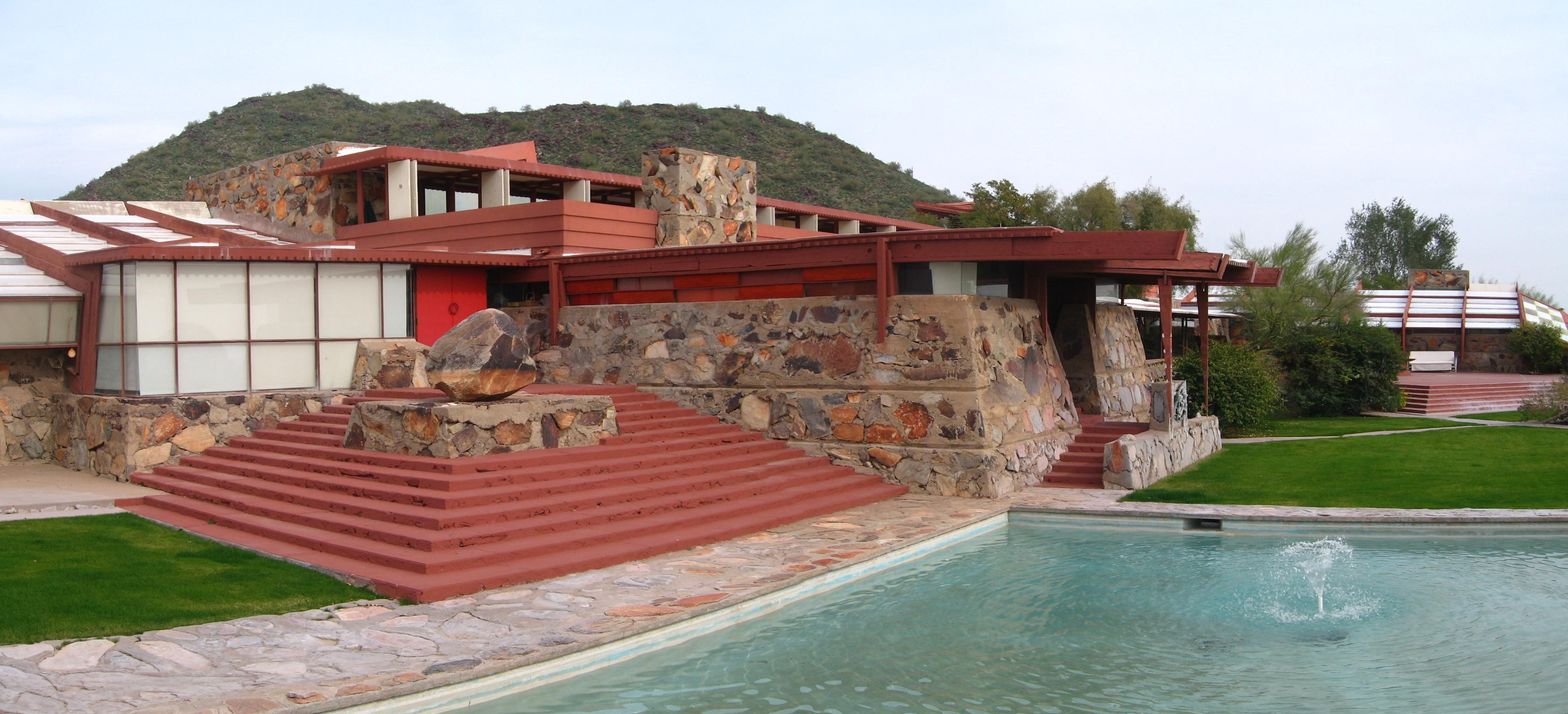
Photograph by Greg O'Beirne · CC BY · via Wikimedia Commons
Why It Matters
Rising from the rock and sand of the Sonoran Desert north of Scottsdale, Taliesin West shows Frank Lloyd Wright reinventing his architecture for an entirely different landscape than his native Midwest. Built with 'desert masonry' of local stone set in concrete, canvas-covered roofs, and structures that seem to grow directly from the terrain, it served as Wright's winter home, working studio, and architecture school for over twenty years and remains one of the most complete expressions of his late organic style.
The History
In the mid-1930s, Frank Lloyd Wright, then in his late sixties and seeking relief from Wisconsin winters and a warmer climate for his health, purchased desert land near Scottsdale, Arizona. Beginning in 1937, he and his apprentices from the Taliesin Fellowship built Taliesin West largely by hand, quarrying local rock and using it in a technique Wright called 'desert masonry,' set with the same warm color as the surrounding land.
The complex included Wright's living quarters, drafting studios, a theater, and workshops, originally sheltered by canvas-and-redwood-frame roofs designed to filter the harsh desert light, later replaced with more permanent materials as the buildings evolved over decades of continuous modification. Wright and his apprentices treated the camp as a living laboratory, constantly experimenting and rebuilding parts of the complex even as it served as a functioning school.
Wright wintered at Taliesin West with the Fellowship until his death in 1959, after which it continued as the winter campus of the Frank Lloyd Wright School of Architecture. It was designated a National Historic Landmark in 1982 and named a UNESCO World Heritage Site in 2019, one of eight Wright buildings recognized together as 'The 20th-Century Architecture of Frank Lloyd Wright.'
Through the Years
- 1937
Construction begins on Taliesin West in the Arizona desert
- 1940s
Wright and apprentices continually expand and rebuild the complex
- 1959
Frank Lloyd Wright dies; the Fellowship continues at Taliesin West
- 1982
Taliesin West is designated a National Historic Landmark
- 2019
Taliesin West is named a UNESCO World Heritage Site
The Archive
 Plate 01
Taliesin West Drafting Studio.
Steven C. Price · CC BY-SA · via Wikimedia Commons
 Plate 02
Taliesin West Garden Room Main Room.
Steven C. Price · CC BY-SA · via Wikimedia Commons
 Plate 03
One of the Petrographs which adorn Taliesin West.
Steven C. Price · CC BY-SA · via Wikimedia Commons
 Plate 04
Fountain and terrace, with dining and dormitory area beyond, Taliesin West.
Lar (primary) User:Lar (secondary) · Public domain · via Wikimedia Commons
Facts & Figures
History
- Construction begun
- 1937
Architecture
- Technique
- 'Desert masonry' of local stone
- Style
- Organic / Desert Modernism
Use
- Function
- Wright's winter home, studio & school
Designation
- National Historic Landmark
- Designated 1982
- UNESCO World Heritage Site
- Inscribed 2019
Related site
- Summer counterpart
- Taliesin, Wisconsin
The Register
- Architectural style
- Organic architecture / Desert Modernism
- Builder
- Frank Lloyd Wright
- Area of significance
- Architecture; American modernism
- County
- Maricopa
- Acreage
- 620 acres
- National Register ref.
- 74000457
- Listed on the Register
- February 12, 1974
Frequently Asked
Why did Frank Lloyd Wright build Taliesin West?
In the 1930s Wright sought a warmer winter home and a new architectural laboratory, building Taliesin West in the Arizona desert beginning in 1937 as a winter counterpart to his Wisconsin home, Taliesin.
What is 'desert masonry'?
It's Wright's construction technique using local desert stone set in concrete forms, designed so the buildings blend visually with the surrounding Sonoran Desert landscape.
Is Taliesin West a UNESCO World Heritage Site?
Yes, since 2019, as one of eight Frank Lloyd Wright buildings collectively inscribed as 'The 20th-Century Architecture of Frank Lloyd Wright.'
Can you visit Taliesin West?
Yes. The Frank Lloyd Wright Foundation offers guided tours of the complex near Scottsdale, Arizona, year-round.