- The 20th Century (1900–2000)
- 43.1467° N, 90.0731° W
Taliesin
Spring Green, Wisconsin · Established 1911
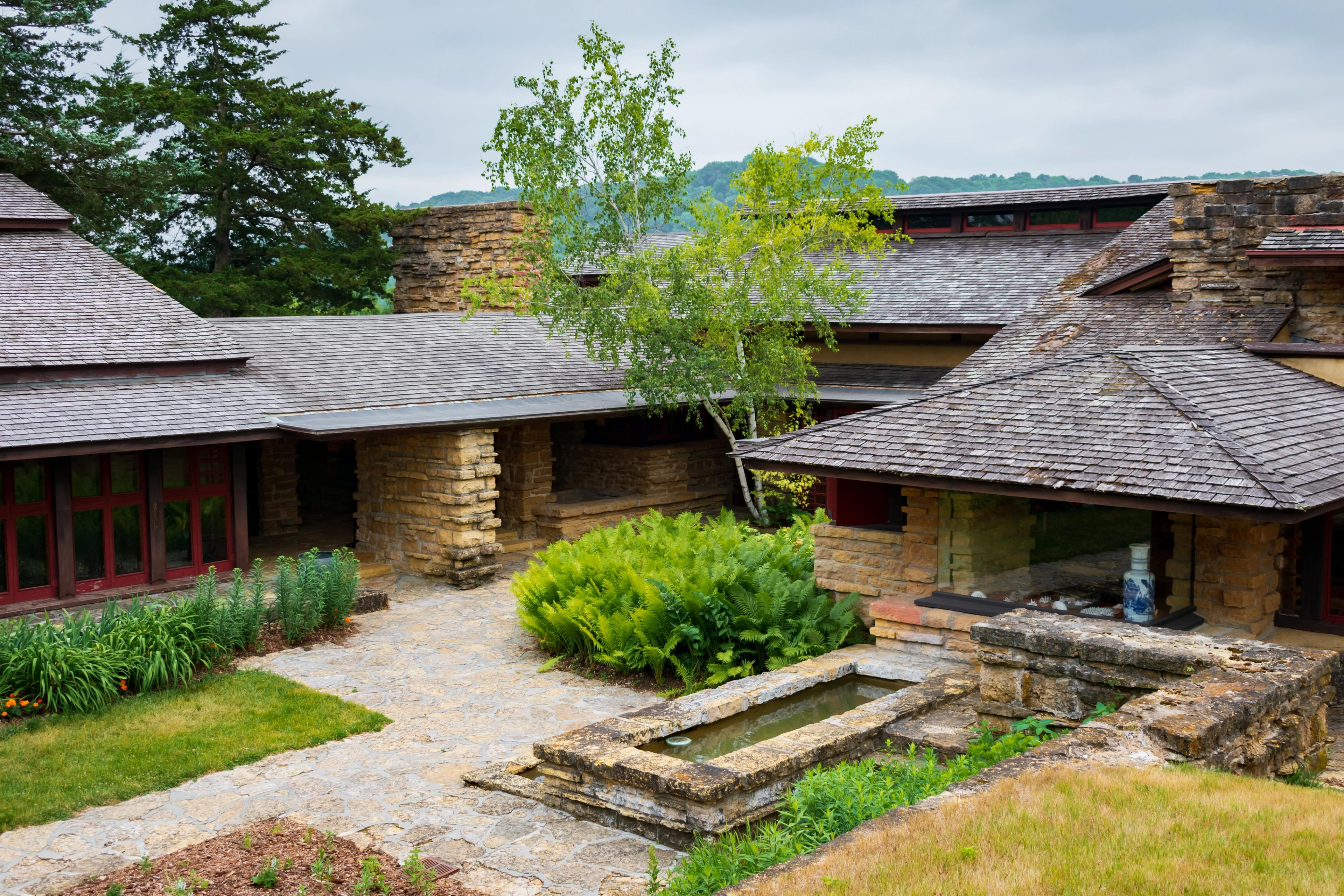
Bahrsoap · CC BY-SA · via Wikimedia Commons
Why It Matters
Taliesin was where Frank Lloyd Wright retreated to remake both his personal life and his architecture, building a home into the very hillside of his family's ancestral Wisconsin valley. It became his primary residence, working studio, and architecture school for nearly five decades, and the site of one of the most horrific tragedies in American architectural history. Rebuilt twice after fire, Taliesin embodies both Wright's philosophy of organic architecture and the turbulence of the life he lived pursuing it.
The History
Frank Lloyd Wright built Taliesin in 1911 on land near Spring Green, Wisconsin, that had belonged to his mother's Welsh family for generations, retreating there amid a personal scandal after leaving his first wife for Mamah Borthwick Cheney. He named the estate Taliesin, Welsh for 'shining brow,' reflecting his design philosophy of building structures into hillsides rather than atop them.
On August 15, 1914, while Wright was away in Chicago, a servant set fire to the living quarters and murdered seven people with an axe, including Mamah Borthwick and her two children. Wright rebuilt the house, called Taliesin II, but a second fire caused by an electrical fault destroyed much of it again in 1925, prompting a third rebuilding, Taliesin III, incorporating stone, wood, and glass in the organic style Wright continued refining for the rest of his career.
In 1932 Wright and his third wife, Olgivanna, founded the Taliesin Fellowship, an apprenticeship program that brought aspiring architects to live and work alongside Wright, blending architectural training with farming and communal living. Wright split his time between Taliesin and its winter counterpart, Taliesin West in Arizona, until his death in 1959. Taliesin is now preserved by the Frank Lloyd Wright Foundation and was designated a National Historic Landmark in 1976.
Through the Years
- 1911
Frank Lloyd Wright builds Taliesin on his family's Wisconsin land
- 1914
A servant sets fire to the house and kills seven people on August 15
- 1925
A second fire destroys much of the rebuilt Taliesin II
- 1932
Wright and Olgivanna found the Taliesin Fellowship
- 1959
Frank Lloyd Wright dies; the Fellowship continues at Taliesin
- 1976
Taliesin is designated a National Historic Landmark
The Archive
 Plate 01
Sign at Taliesin entrance.
Quapet · Public domain · via Wikimedia Commons
 Plate 02Historic · 2007
Winter photograph of Taliesin.
Library of Congress · No known restrictions · via Library of Congress
 Plate 03
Jan. 4th, 2008 Frank Lloyd Wright's Taliesin, outside of Spring Green, Wis. Taken from Cty. Hwy C. Taliesin
Cindy · CC BY-SA · via Wikimedia Commons
Facts & Figures
History
- Built
- 1911
- 1914 tragedy
- Arson and murder of 7 people
- 1925 fire
- Electrical fire destroys Taliesin II
Meaning
- Name
- Welsh for 'shining brow'
Education
- Taliesin Fellowship
- Founded 1932
Architecture
- Style
- Organic architecture
Designation
- National Historic Landmark
- Designated 1976
The Register
- Architectural style
- Prairie School / Organic architecture
- Builder
- Frank Lloyd Wright
- Area of significance
- Architecture; American modernism
- County
- Iowa
- Acreage
- 490 acres
- National Register ref.
- 73000081
- Listed on the Register
- April 14, 1973
Frequently Asked
What does 'Taliesin' mean?
It's Welsh for 'shining brow,' reflecting Frank Lloyd Wright's philosophy of siting buildings into the brow of a hill rather than on its summit.
What tragedy happened at Taliesin?
On August 15, 1914, a servant set fire to the living quarters and killed seven people with an axe, including Wright's partner Mamah Borthwick Cheney and her two children.
Why was Taliesin rebuilt multiple times?
After the 1914 arson, Wright rebuilt it as Taliesin II. A second, accidental electrical fire in 1925 destroyed much of that structure, leading to the current Taliesin III.
Can you visit Taliesin today?
Yes. Taliesin Preservation offers guided tours of the house, studio, and grounds seasonally in rural Spring Green, Wisconsin.