- The 20th Century (1900–2000)
- 41.7911° N, 87.5892° W
Robie House
Chicago, Illinois · Established 1910
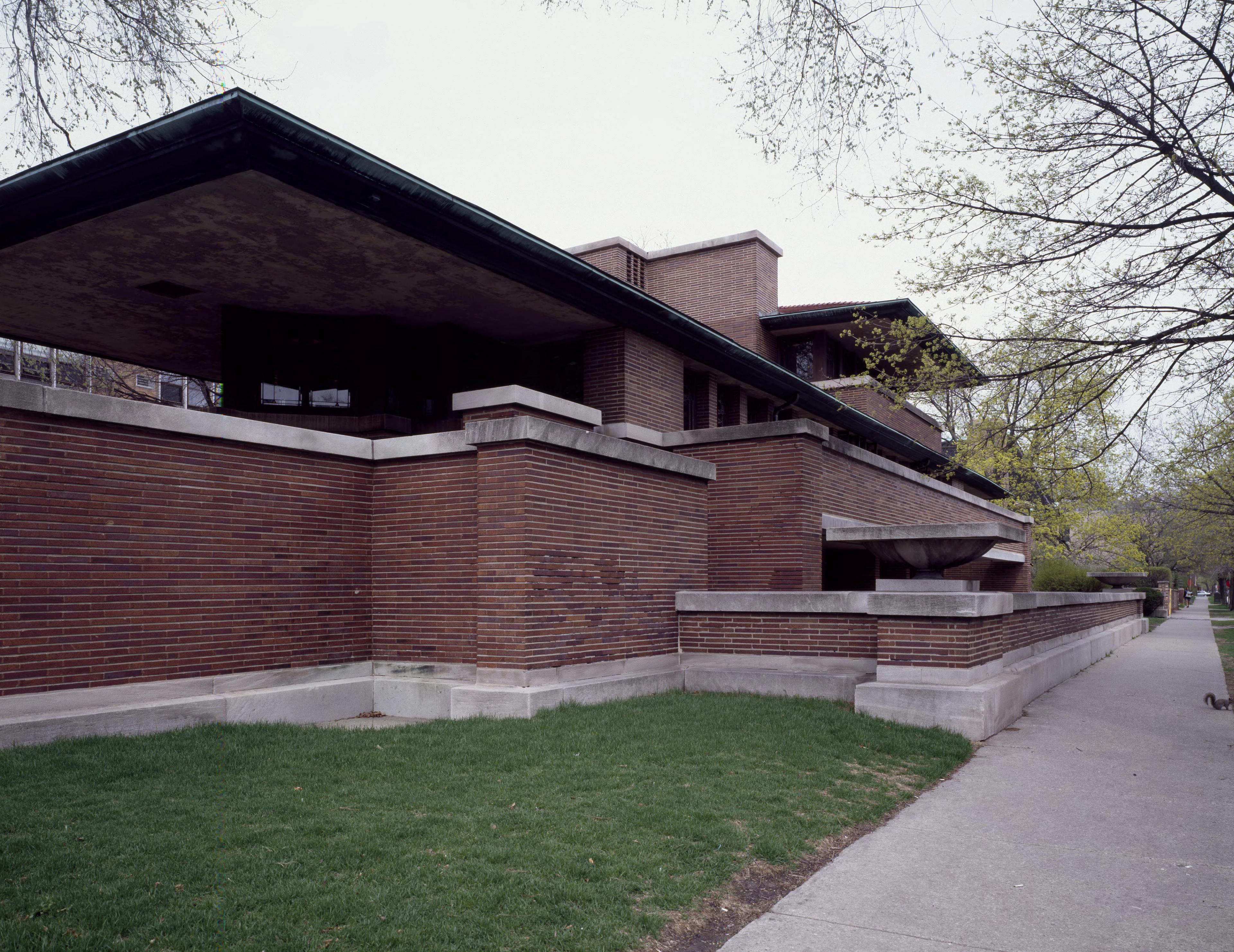
Carol M. Highsmith Archive, Library of Congress · No known restrictions · via Library of Congress
Why It Matters
With its dramatic cantilevered roofs sweeping low over ribbons of art glass windows, Robie House announced a fully American architecture, breaking decisively from European tradition to celebrate the flat horizontal lines of the Midwestern prairie. Frank Lloyd Wright considered it the purest expression of his Prairie School philosophy, and architectural historians regard it as one of the most influential buildings of the 20th century, a direct ancestor of modernist residential design worldwide.
The History
Bicycle and motorcycle manufacturer Frederick C. Robie commissioned Frank Lloyd Wright in 1908 to design a modern home for his young family in Chicago's Hyde Park neighborhood, near the University of Chicago. Wright, already refining his Prairie School ideas over the previous decade, used the commission to push the style to its most complete realization, integrating structure, furnishings, and site into a single unified design.
Completed in 1910, the house's long, low profile, dramatic overhanging eaves, and open interconnected living spaces rejected the boxy Victorian houses of the era in favor of horizontal lines meant to echo the flat prairie landscape. Wright designed nearly every element himself, from the leaded art-glass windows to built-in furniture, achieving the 'total work of art' ideal central to his philosophy. Robie, however, lived in the house for only about a year before financial troubles forced its sale.
The house passed through several owners and was twice threatened with demolition, in the 1940s and again in the 1950s, both times saved by preservation campaigns that included direct appeals by Wright himself, then in his eighties. The University of Chicago eventually acquired the property, and after decades of use for university offices, a major restoration beginning in 2002 returned Robie House to its original 1910 appearance. It was designated a National Historic Landmark in 1963 and is now a museum operated by the Frank Lloyd Wright Trust.
Through the Years
- 1908
Frederick C. Robie commissions Frank Lloyd Wright to design the house
- 1910
Robie House is completed
- 1911
Robie sells the house after financial troubles
- 1957
A preservation campaign, aided by Wright himself, saves the house from demolition
- 1963
Robie House is designated a National Historic Landmark
- 2002
A major restoration begins to return the house to its 1910 appearance
The Archive
 Plate 01
Frank Lloyd Wright's studio at the Robie House in Chicago, Illinois.
Carol M. Highsmith Archive, Library of Congress · No known restrictions · via Library of Congress
 Plate 02
The Robie House windows from the exterior.
Kidfly182 · CC BY · via Wikimedia Commons
 Plate 03
Robie House interior photograph in the Hyde Park neighborhood, Chicago, Illinois.
Carol M. Highsmith Archive, Library of Congress · No known restrictions · via Library of Congress
 Plate 04
The Robie House in the Hyde Park neighborhood of Chicago.
Kidfly182 · CC BY · via Wikimedia Commons
 Plate 05
The Robie House exterior view in the Hyde Park neighborhood of Chicago
Kidfly182 · CC BY · via Wikimedia Commons
Facts & Figures
History
- Client
- Frederick C. Robie
- Completed
- 1910
- Threatened demolition
- 1940s and 1950s
Architecture
- Style
- Prairie School
- Architect
- Frank Lloyd Wright
Designation
- National Historic Landmark
- Designated 1963
Restoration
- Major restoration
- Begun 2002
The Register
- Area of significance
- Architecture; American modernism
Frequently Asked
Why is Robie House architecturally significant?
It's considered the purest expression of Frank Lloyd Wright's Prairie School style, with its horizontal lines, cantilevered roofs, and integrated design influencing residential architecture worldwide.
Did Frederick Robie live in the house long?
No. Financial difficulties forced Robie to sell the house after only about a year, despite it being custom-built for his family.
Was Robie House ever nearly demolished?
Yes, twice — in the 1940s and 1950s. Preservation campaigns, including direct appeals from an elderly Frank Lloyd Wright, saved the building both times.
Can you visit Robie House today?
Yes. The Frank Lloyd Wright Trust operates it as a museum with guided tours of the restored interior on Chicago's Hyde Park campus.