- The 20th Century (1900–2000)
- 41.5087° N, 81.6954° W
Rock and Roll Hall of Fame
Cleveland, Ohio · Established 1983
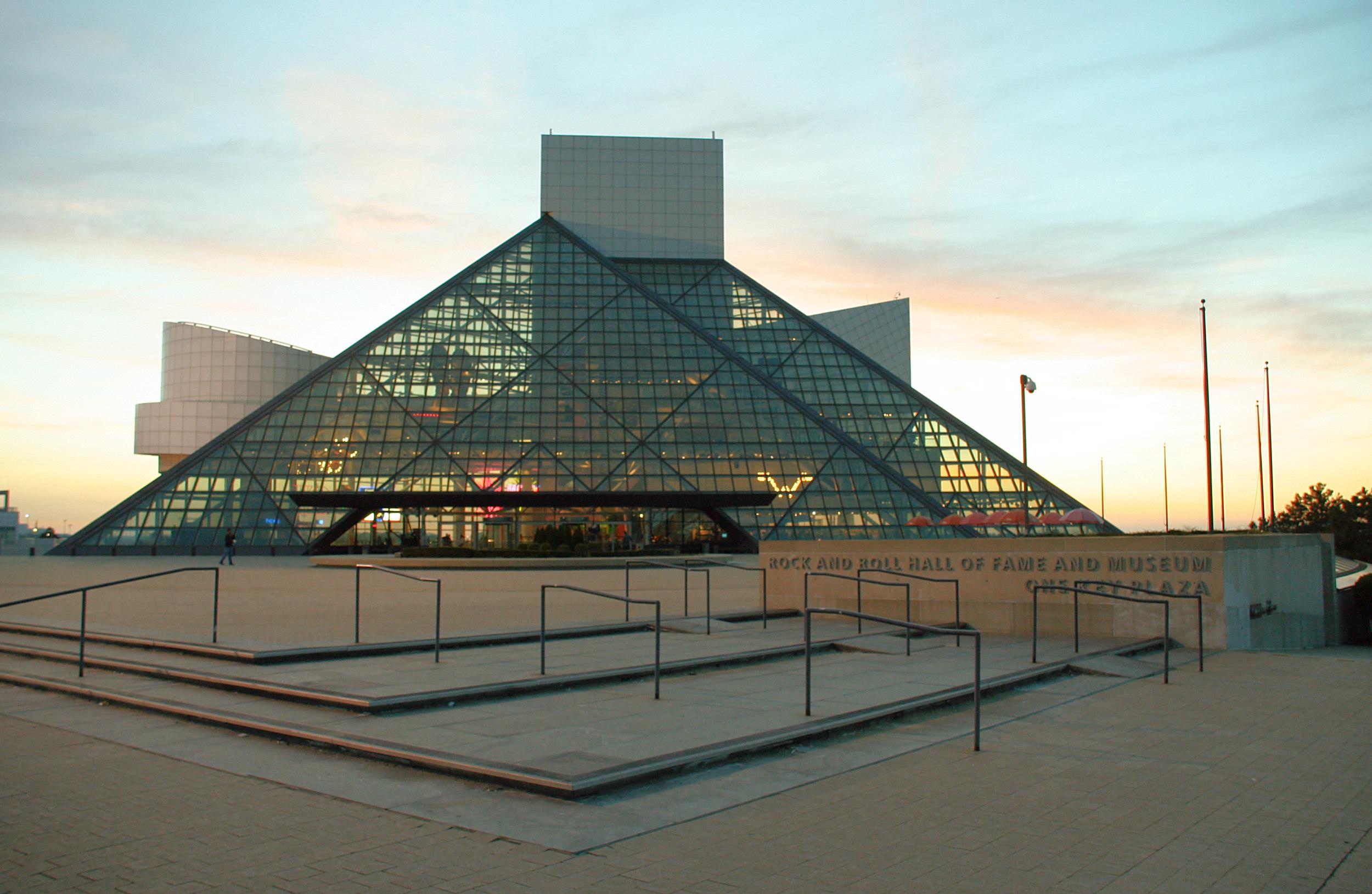
Derek Jensen ( Tysto ) · Public domain · via Wikimedia Commons
Why It Matters
A glass pyramid on the shore of Lake Erie housing the artifacts of a genre born from radio, rebellion, and racial crossover, the Rock and Roll Hall of Fame gave a permanent home to a history that for years existed only as an idea and an induction ceremony.
The History
A group of music industry figures including Atlantic Records co-founder Ahmet Ertegun established the Rock and Roll Hall of Fame Foundation in 1983 to formally recognize the musicians, producers, and executives who shaped rock music. The foundation held its first induction ceremony in New York in 1986, honoring early pioneers including Chuck Berry, James Brown, Ray Charles, Sam Cooke, Fats Domino, Buddy Holly, Jerry Lee Lewis, Elvis Presley, and Little Richard, years before any physical museum existed.
Several cities lobbied to host a permanent museum, and Cleveland won the site in the late 1980s, aided by the city's rock radio history and a large fan campaign organized by local station WMMS. Architect I.M. Pei, already famous for the Louvre Pyramid in Paris, designed a striking glass pyramid rising from a cylindrical tower on the shore of Lake Erie.
The museum opened to the public in 1995, finally giving the foundation's decade of inductees a permanent home for donated instruments, stage costumes, and handwritten lyrics. Artists remain eligible for induction 25 years after their first commercial recording, a rule that keeps the Hall's story continuously expanding alongside the genre it honors.
Through the Years
- 1983
The Rock and Roll Hall of Fame Foundation is established
- 1986
The first induction ceremony is held in New York
- 1995
The museum building, designed by I.M. Pei, opens in Cleveland
The Archive
 Plate 01
Exterior shot of the Rock and Roll Hall of Fame.
Astra Vero · CC BY-SA · via Wikimedia Commons
 Plate 02
Guitars outside the Rock and Roll Hall of Fame.
Andrew Hitchcock · CC BY · via Wikimedia Commons
 Plate 03
Front view of the Rock and Roll Hall of Fame structure.
Darkfighter101 · CC BY-SA · via Wikimedia Commons
 Plate 04
Facade of Rock Roll Hall of Fame and Museum.
Adam Jones from Kelowna, BC, Canada · CC BY-SA · via Wikimedia Commons
Facts & Figures
Founding
- Founded
- 1983, by a foundation including Atlantic Records co-founder Ahmet Ertegun
- Opened
- 1995, on the shore of Lake Erie
History
- First induction
- 1986, in New York, honoring pioneers including Chuck Berry and Elvis Presley
- Location choice
- Cleveland won the museum site in the late 1980s partly on radio history and a fan campaign
Architecture
- Architect
- I.M. Pei
Rules
- Eligibility rule
- Artists qualify 25 years after their first commercial recording
Exhibits
- Collection
- Instruments, costumes, handwritten lyrics, and artifacts donated by inducted artists
The Register
- Established
- 1983
- Architectural style
- Modernist (glass pyramid and tower)
- Builder
- I.M. Pei (architect)
- Area of significance
- Music, Popular Culture, Architecture
Frequently Asked
Why is the Rock and Roll Hall of Fame in Cleveland?
Cleveland lobbied hard for the museum in the late 1980s, citing the city's rock radio history and organizing a large fan campaign, and won the site over other candidate cities including New York and Memphis.
When was the first induction ceremony?
In 1986, in New York, nearly a decade before the museum building in Cleveland opened, honoring early rock pioneers such as Chuck Berry, Ray Charles, and Elvis Presley.
Who designed the museum building?
Architect I.M. Pei, known for works like the Louvre Pyramid, designed the museum's distinctive glass pyramid and tower structure on the shore of Lake Erie.
How does an artist become eligible for induction?
Artists become eligible 25 years after the release of their first commercial recording, though eligibility does not guarantee induction, which is voted on by an international panel.