- The 20th Century (1900–2000)
- 40.7489° N, 73.9680° W
United Nations Headquarters
New York, New York · Established 1947
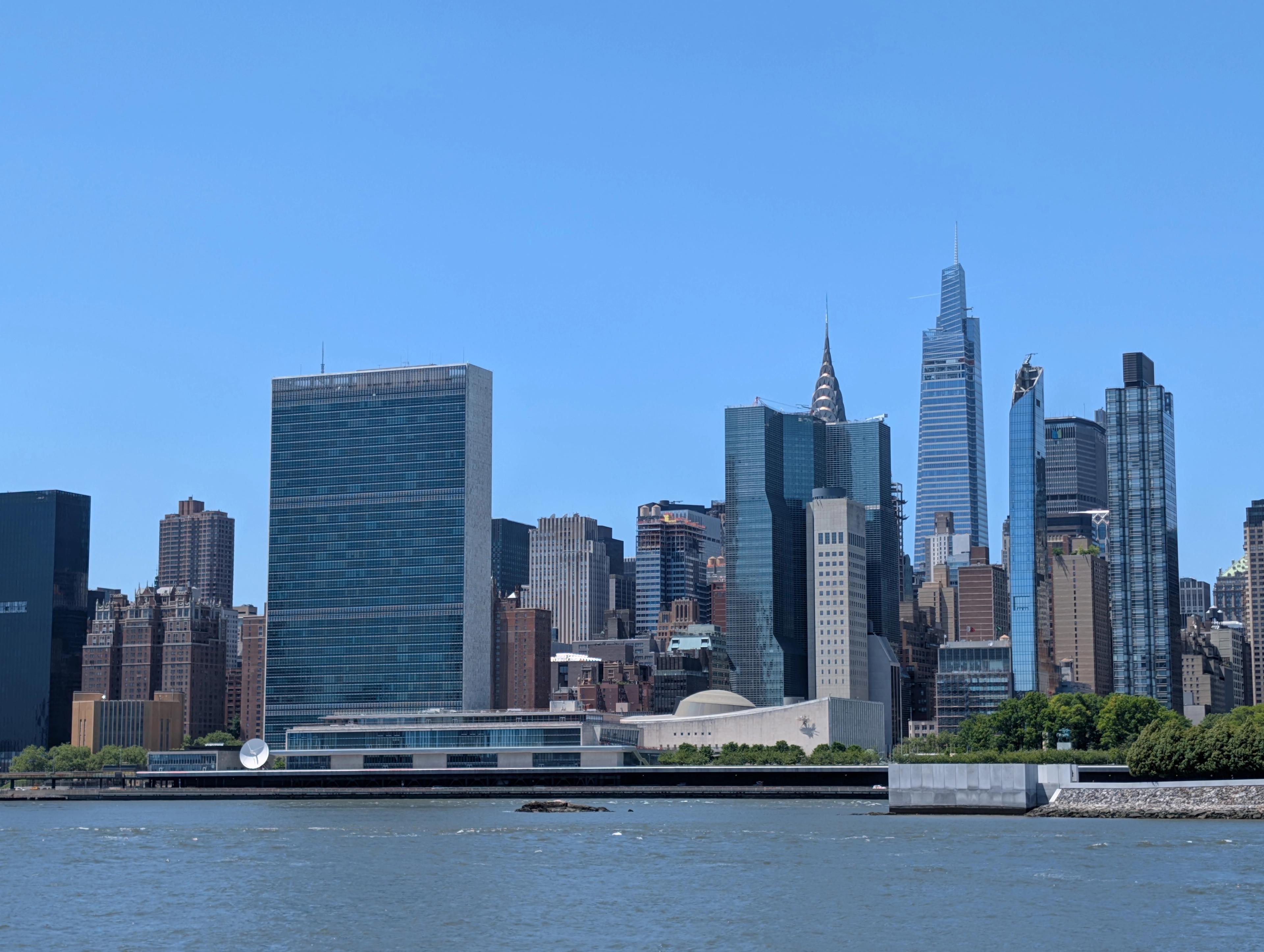
Nanagrams · CC BY-SA · via Wikimedia Commons
Why It Matters
Built on land donated by an American oil dynasty and designed by architects from a dozen countries, the UN Headquarters gave a fragile postwar experiment in international cooperation a permanent home overlooking the East River.
The History
The United Nations was founded in 1945, when representatives of 50 nations signed the UN Charter in San Francisco in the aftermath of World War II, hoping to succeed where the failed League of Nations had not. The fledgling organization initially lacked a permanent home, and in 1946 John D. Rockefeller Jr. donated $8.5 million to purchase a stretch of industrial waterfront along Manhattan's East River as a headquarters site.
An international Board of Design led by American architect Wallace Harrison oversaw the project, drawing heavily on competing concepts submitted by French-Swiss architect Le Corbusier and Brazilian architect Oscar Niemeyer, whose rival schemes were ultimately merged into the final plan. Construction proceeded from 1947 to 1952, producing a complex centered on the 39-story Secretariat Building, whose glass-curtain-wall design became one of the most influential and widely imitated skyscraper styles of the 20th century.
Although it occupies ordinary New York City land, the complex operates under special legal privileges established by the 1947 UN Headquarters Agreement, giving it a measure of independence from certain local and national laws. In the decades since, member nations have filled its halls with donated artwork and gifts, turning the complex into an informal museum of international diplomacy alongside its working role as the UN's political and administrative center.
Through the Years
- 1945
The UN Charter is signed in San Francisco, founding the United Nations
- 1946
John D. Rockefeller Jr. donates funds to purchase the East River site
- 1947
Construction begins on the headquarters complex
- 1952
The complex is completed and the UN moves in
The Archive
 Plate 01
United Nations Headquarters, seen from an NYC Ferry on the East River.
Joe Mabel · CC BY-SA · via Wikimedia Commons
 Plate 02Historic · 1958
Historic photograph of flags in front of the United Nations Headquarters.
Library of Congress · No known restrictions · via Library of Congress
Facts & Figures
Founding
- Site
- Purchased with an $8.5 million gift from John D. Rockefeller Jr.
- Construction
- 1947-1952
Architecture
- Design
- International Board of Design led by Wallace Harrison, with input from Le Corbusier and Oscar Niemeyer
- Secretariat Building
- 39-story International Style tower, highly influential in later skyscraper design
History
- UN founding
- Charter signed 1945 in San Francisco, after World War II and the League of Nations' collapse
Governance
- Legal status
- Operates under special privileges from the 1947 UN Headquarters Agreement
Culture
- Art collection
- Contains gifts and artwork from member nations throughout the complex
The Register
- Established
- 1947
- Architectural style
- International Style
- Builder
- Wallace Harrison (lead architect), with Le Corbusier and Oscar Niemeyer
- Area of significance
- Diplomacy, Architecture, International Relations
Frequently Asked
Is the UN Headquarters technically part of the United States?
Yes, it sits on regular New York City soil, but the 1947 UN Headquarters Agreement grants the complex certain special privileges and immunities, giving it a degree of independence from some local and national laws.
Who designed the UN Headquarters?
An international Board of Design led by American architect Wallace Harrison, drawing heavily on rival design concepts submitted by French-Swiss architect Le Corbusier and Brazilian architect Oscar Niemeyer.
Why is the Secretariat Building architecturally significant?
Its 39-story glass-curtain-wall design was one of the first of its scale and became one of the most influential and widely imitated skyscraper styles worldwide in the following decades.
How did the UN acquire its headquarters site?
John D. Rockefeller Jr. donated $8.5 million to purchase the East River site in 1946, after New York City was chosen over other candidate locations.