20th Century · South Dakota
Crazy Horse Memorial
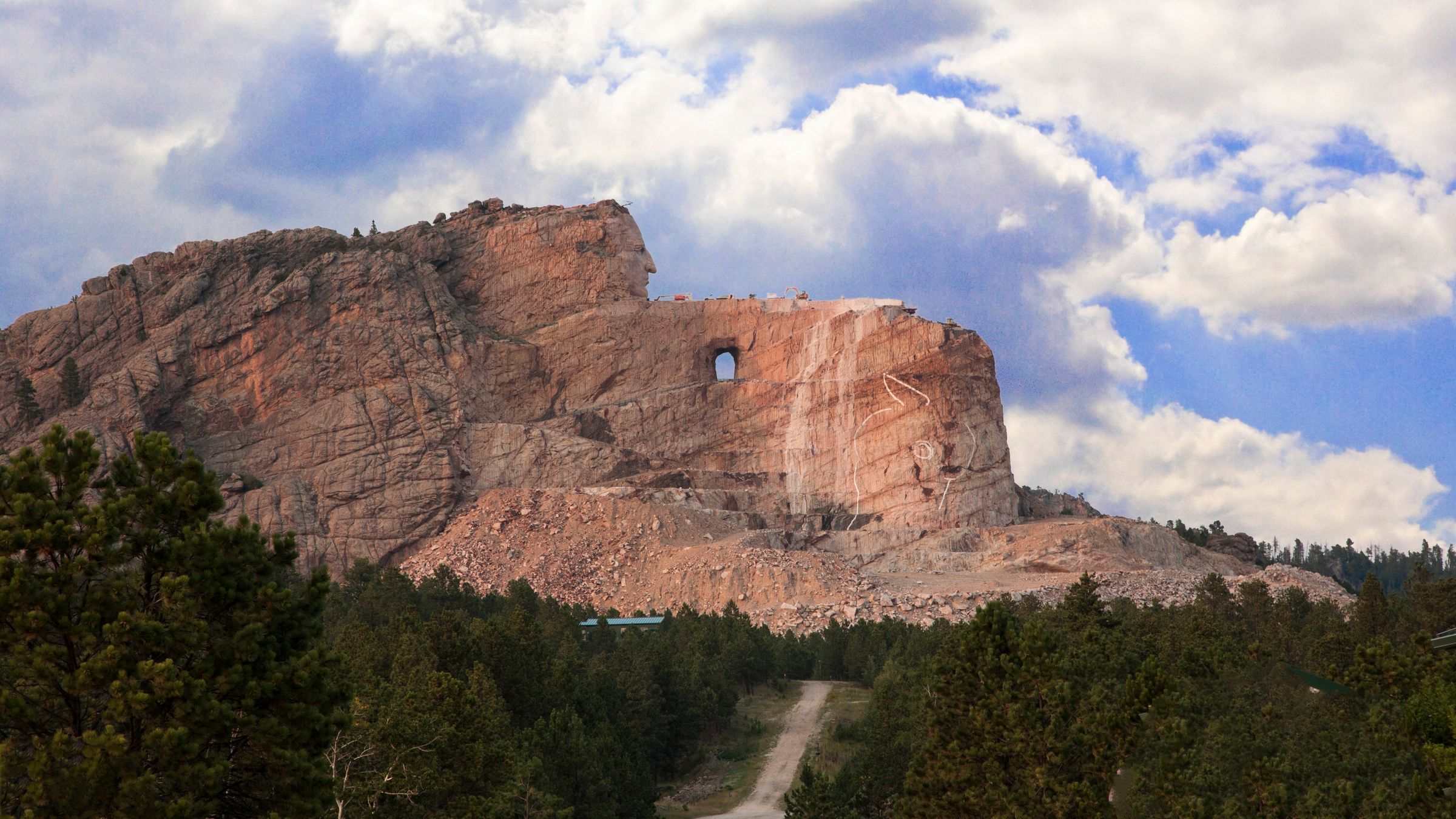
The Crazy Horse Memorial, still under construction. — Ahzoov
Why Crazy Horse Memorial Matters
Conceived as an answer to Mount Rushmore's monument to American presidents, Crazy Horse Memorial is a still-unfinished, entirely privately funded mountain carving meant to honor Native American history and dignity on the same scale the nation gave its presidents.
By the Numbers
People
- Sculptor
- Korczak Ziolkowski, who had worked as an assistant on Mount Rushmore
Founding
- Commissioned by
- Lakota elder Henry Standing Bear, 1939
- Construction began
- June 3, 1948
Funding
- Funding model
- Entirely private — Ziolkowski twice declined $10 million in federal funding
Scale
- Face height
- 87 feet tall, taller than the 60-foot faces at Mount Rushmore
History
- Face completed
- 1998, fifty years after blasting began
Site
- Additional facilities
- Indian Museum of North America and Native American Educational and Cultural Center
Timeline
- 1939Henry Standing Bear invites Korczak Ziolkowski to carve a memorial honoring Native Americans
- 1948Ziolkowski begins blasting the mountain on June 3
- 1982Ziolkowski dies; his wife Ruth and family continue the project
- 1998Crazy Horse's face is completed and dedicated
Complete History
In 1939, Lakota elder Henry Standing Bear wrote to sculptor Korczak Ziolkowski, who had worked as an assistant on Mount Rushmore, inviting him to carve a mountain memorial so that 'the white man will know the red man had great heroes, too.' Standing Bear proposed honoring Crazy Horse, the Lakota war leader famous for his role in defeating Custer at the Battle of the Little Bighorn in 1876, of whom no verified photograph is known to exist.
Ziolkowski began blasting the mountain on June 3, 1948, working largely alone for years with primitive equipment. He insisted the project remain independent of government money, twice declining offers of $10 million in federal funding so that it would be built, in his words, 'by the people.' The scale of the design is immense: Crazy Horse's face alone measures 87 feet tall, taller than any of the four presidential faces at nearby Mount Rushmore.
Ziolkowski died in 1982, decades before the carving's completion, and his wife Ruth and their children continued the work. The face was finally completed and dedicated in 1998, fifty years after blasting began, but the horse and Crazy Horse's outstretched arm remain unfinished. The site also houses the Indian Museum of North America and the Native American Educational and Cultural Center, funded, like the carving itself, entirely by admission fees and private donations.
Historic Images
Interesting Facts
- The memorial has been under construction since 1948 and remains unfinished more than 75 years later.
- Sculptor Korczak Ziolkowski worked on Mount Rushmore before starting this project.
- Crazy Horse's face alone is 87 feet tall — taller than any of the four presidential faces at Mount Rushmore.
- The project is funded entirely by admission fees and private donations; it has twice refused federal funding.
- Ziolkowski's wife and children have continued the carving since his death in 1982.
Visiting Today
- Hours
- Daily; hours vary seasonally
- Admission
- Paid admission (funds the ongoing carving)
- Best time to visit
- Evening for the laser-light show held in summer months
- Nearby
- Mount Rushmore, Custer State Park, Wind Cave National Park
The Indian Museum of North America on site is included with admission and offers extensive context on Native nations of the Plains
Frequently Asked Questions
Why has the memorial taken so long to build?
It is an enormous mountain-scale sculpture funded entirely by admission fees and private donations rather than government money, which the sculptor twice declined in order to keep the project independent — a decision that has slowed its pace but preserved its independence.
Who was Crazy Horse?
Crazy Horse was a Lakota war leader famous for his role in defeating Custer at the Battle of the Little Bighorn in 1876; no verified photograph of him is known to exist.
Is the memorial finished?
No. Only Crazy Horse's face, completed in 1998, is finished; work continues on the horse and the rest of the figure.
Who is building it now?
The family of original sculptor Korczak Ziolkowski, who died in 1982, has continued the carving, along with the nonprofit Crazy Horse Memorial Foundation.