Colonial · Massachusetts
Plymouth Rock
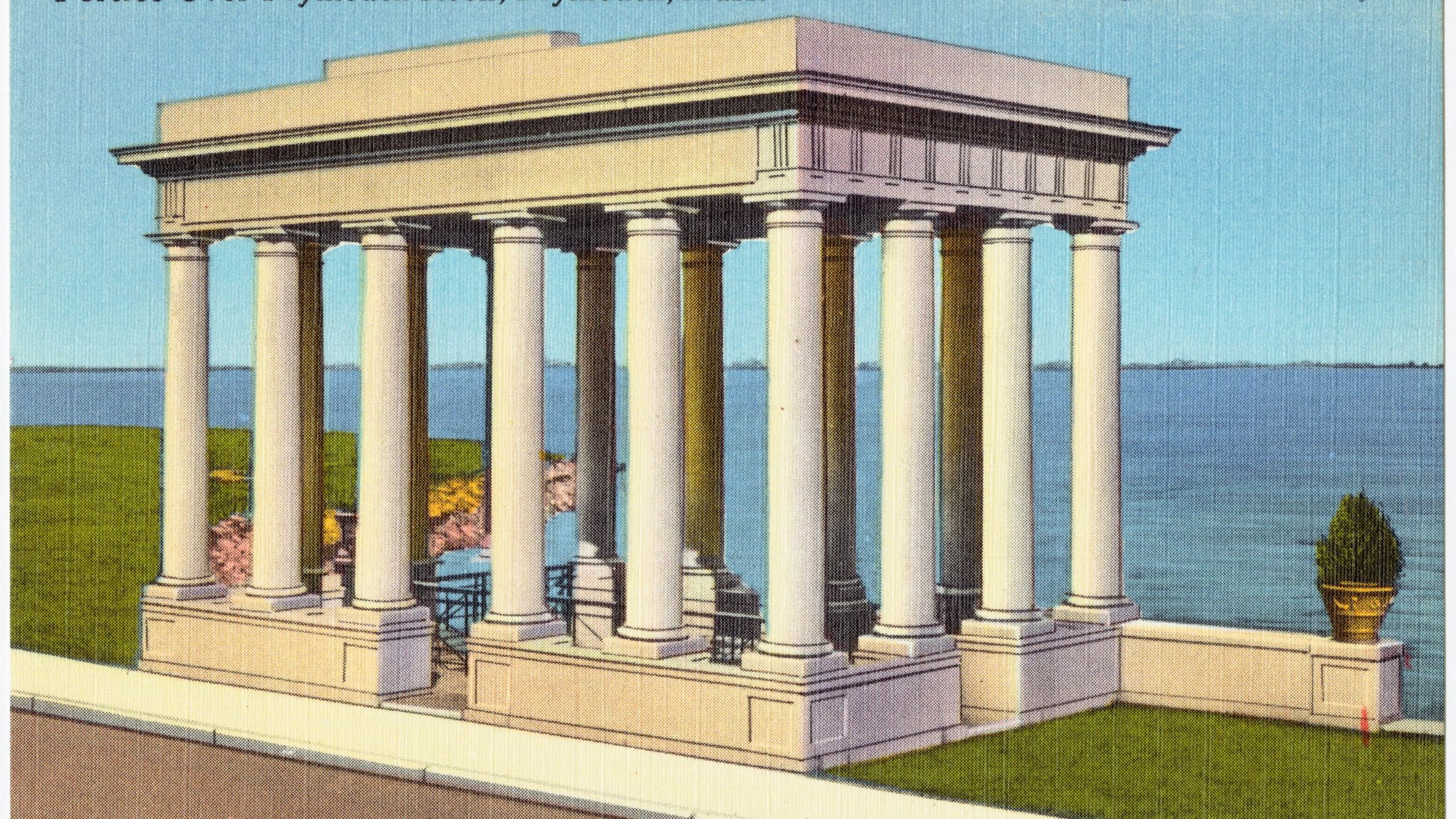
The portico sheltering Plymouth Rock. — Pub. by Smith's Inc., Plymouth, Mass. Tichnor Bros. Inc., Boston, Mass.
Why Plymouth Rock Matters
Few American landmarks carry more symbolic weight on so little historical evidence than Plymouth Rock. Revered for two centuries as the exact spot where the Mayflower Pilgrims first stepped ashore in 1620, the modest granite boulder has become shorthand for the entire founding myth of English colonial America — even though no contemporary Pilgrim account mentions a rock at all. Its story says as much about how nations build memory as it does about 1620 itself.
By the Numbers
History
- Pilgrims land
- December 1620
- First identified
- 1741, by Thomas Faunce
- Split in two
- 1774
- Current site since
- 1920 (300th anniversary)
Inscription
- Marking
- '1620' carved into the rock
Historiography
- Evidence
- No contemporary Pilgrim mention of a rock
Site
- Park
- Pilgrim Memorial State Park
Timeline
- 1620The Mayflower Pilgrims settle Plymouth in December
- 1741Thomas Faunce first identifies the boulder as the landing site
- 1774Patriots split the rock while attempting to move it
- 1880The rock's two halves are reunited at the waterfront
- 1920The rock is set at its current site for the 300th anniversary
Complete History
The Mayflower, carrying 102 passengers seeking religious freedom and economic opportunity, anchored in Provincetown Harbor in November 1620 before Pilgrim colonists moved on to settle Plymouth in December. No Pilgrim writing from that era mentions a landing rock; the first documented association between the Pilgrims and 'the Rock' came 121 years later, in 1741, when 94-year-old Thomas Faunce, whose father arrived in Plymouth in 1623, identified the boulder as the traditional landing site shortly before it was to be buried under a wharf.
In 1774, patriots attempting to move the rock as a symbol of liberty split it in two; the top half was relocated to the town square and later moved several more times as its symbolic importance grew through the 19th century, especially as national origin stories became politically useful. The rock was reunited and moved to its current waterfront location in 1880, then set into the beach at its present site in 1920 for the 300th anniversary of the landing, beneath a Classical portico built to shelter it.
Today the rock is a fraction of its original size, worn by souvenir-taking and repeated relocations, and inscribed simply '1620.' Historians widely regard the landing story as legend rather than documented fact, but the site remains one of the most visited symbols of American colonial memory, part of Pilgrim Memorial State Park alongside a replica of the Mayflower II and Plimoth Patuxet Museums nearby.
Historic Images

Interesting Facts
- No surviving Pilgrim account from 1620 mentions a landing rock; the story first appears in 1741, 121 years later.
- Patriots split the rock in half in 1774 while trying to move it as a symbol of liberty.
- The rock has been relocated several times and is only a fraction of its original size due to souvenir-taking.
- It was set at its current beachfront site in 1920 to mark the 300th anniversary of the Pilgrims' landing.
- A replica of the Mayflower II and the Plimoth Patuxet Museums are nearby, telling the fuller story of the colony.
Visiting Today
- Hours
- The waterfront site is outdoors and accessible at all times; nearby museums keep seasonal hours.
- Admission
- Free to view the rock; the Mayflower II and Plimoth Patuxet Museums charge separate admission.
- Best time to visit
- Spring through fall, when the Mayflower II and living-history museums are fully open.
- Nearby
- Historic downtown Plymouth, the Mayflower II, and Plimoth Patuxet Museums are all close by.
Manage expectations — the rock itself is small. Pair the visit with the Mayflower II and Plimoth Patuxet Museums for the fuller, better-documented story of the colony.
Frequently Asked Questions
Did the Pilgrims really land on Plymouth Rock?
There's no contemporary evidence for it. No Pilgrim account from 1620 mentions a rock; the tradition first appears in 1741, over a century later, making it more legend than documented history.
Why is Plymouth Rock split?
Patriots accidentally split it in half in 1774 while trying to move it as a symbol of colonial liberty in the years before the Revolution.
Why is Plymouth Rock so small?
Souvenir hunters chipped away pieces over more than a century, and the rock has been split and relocated several times, leaving only a fraction of its original size.
What else can you see at Plymouth Rock?
The rock sits within Pilgrim Memorial State Park on Plymouth's waterfront, near a full-scale replica of the Mayflower II and the living-history Plimoth Patuxet Museums.